
Looking to add a handmade touch to your holiday décor? These DIY wooden lanterns are the perfect way to bring warmth and charm to your home — no matter the season. Whether you’re decorating for Halloween, Christmas, Valentine’s Day, or even Easter, these lanterns can be customized to suit any celebration.
In my latest YouTube tutorial, I walk you through the step-by-step process of creating wooden holiday lanterns from scratch. It’s a beginner-friendly project for those who are comfortable using basic woodworking tools like a router — and the best part is how easily the lanterns can be personalized for any occasion.
Tools, Materials & Helpful Templates
If you’d like to make these lanterns even easier to build — and add a festive flair — I’ve created a set of router templates and downloadable plans available for purchase! These templates make it simple to add seasonal cutouts to your lanterns, with designs for Halloween (Jack-O’-Lantern faces), Christmas (tree, Santa, snowflake), Valentine’s Day (hearts), and Easter (bunnies and eggs). They’re perfect for giving each lantern a unique holiday personality. You can check them out here:
Whether you’re crafting for personal enjoyment or looking to looking to streamline your builds, these tools will help you get clean, consistent results every time. Here’s a full list of the tools and materials you’ll need:
For these lanterns, I like to start with fence boards, either pine or cedar. Pine has a nice light color, but it often comes with more knots and imperfections — while cedar not only smells amazing but is also more durable if you’re planning to use the lanterns outdoors.
Both are sold as 1x6s, though the actual dimensions are typically around ⅝” thick and 5¼” wide. I prefer to plane the boards down to ½ inch, which helps flatten any cupping and gives a smooth, clean surface to work with. The slightly thinner material also makes it easier to carve decorative patterns with a router.
Cut Lantern Parts to Size
Once your boards are planed and ready, it’s time to cut all the parts to size. I have detailed plans available that include exact measurements for each piece, making it easy to follow along. The design is efficient — you can get enough material for two lanterns from a single 6-foot fence board. Just be sure to measure and mark carefully, especially if you’re working around knots or imperfections in the wood.
Carve the Lantern Face
To carve the design into the lantern face, start by securing your router template to the front panel using double-sided tape. I offer a variety of holiday-themed template collections for purchase, or why not make your own! For the best hold, I use XFasten woodworking tape — it’s hands-down the most reliable double-sided tape I’ve found. It sticks firmly without slipping, yet removes cleanly without damaging the wood or leaving behind any residue.
Once the template is in place, don’t forget to place a sacrificial backer board underneath your workpiece. Since you’ll be routing all the way through the face panel, this extra layer protects your workbench from accidental cuts. I like to use more double-sided tape to secure the workpiece to the backer board.
Setting up Your Router
Setting up your router correctly is key to getting clean, accurate cuts when carving the lantern face. You’ll need to use a guide bushing mounted on your router — this rides along the inside edge of the template to control the shape of the cut. For best results, I recommend a 5/16″ outer diameter guide bushing paired with an extra-long 1/8″ upcut spiral bit. This bit size allows you to follow tight details in the design while the upcut action helps clear debris as you carve. Most importantly, make sure the bit is long enough to plunge all the way through the thickness of your material — I recommend this one for its clean cutting performance and ideal length.
Next, to set the router depth, start by bottoming out the bit in the center of the template to establish a zero point, then adjust the depth rod to slightly over ½ inch — just enough to ensure I cut cleanly through the entire board.
With the router pressed against the template, plunge the bit fully and carefully trace the design in a clockwise direction. I personally prefer making the cut in one deep pass, as it gives a clean edge and saves time, but this does carry a higher risk of overheating or snapping the bit if you’re doing a lot of cuts in a row. Alternatively, you can carve in two shallower passes, which is a bit slower but puts less stress on the bit. Try both methods and see what works best for your setup and comfort level.
Remove the Template and Save for Next Time
Once the carving is complete, use a small pry bar to gently lift off the template — the XFasten tape comes off cleanly without tearing wood fibers, which makes reuse easy. If needed, you can clean the template with 99% isopropyl alcohol, which removes residue without causing damage.
If there’s any roughness or “fuzzies” left behind from the cut, a light pass with 220-grit sandpaper is usually all it takes.
Assemble the Lantern
Now it’s time for assembly. You should have all your parts ready: the face, back, two sides, bottom, and two lid pieces. Most people assemble these using wood glue and brad nails, but if you prefer a cleaner, nail-free look, you can skip the nails — just be prepared to spend a bit more time aligning and clamping everything.
I typically assemble the four sides, then press-fit the bottom, making sure it’s flush, and secure it with brad nails. For the lid, I apply a few dabs of glue, center it by eye (though I’ve included exact measurements in the plans if you want to be more precise), and add a bit of weight to hold it in place while it dries.
Finishing Touches & Safe Lighting
You can leave your lantern unfinished for a rustic look or paint and stain it to match your holiday theme — it’s totally up to you. For the final touch, drop in a flickering flameless tea light. These battery-operated lights are a safe alternative to real candles, giving you that cozy, realistic flicker without any fire risk.
Ready to Light Up Your Holidays?
These DIY wooden lanterns are a rewarding project that brings a personal, handmade touch to your seasonal décor — and they’re just as fun to make as they are to display. With the right tools, a bit of creativity, and the help of my step-by-step video tutorial and downloadable plans, you’ll be well on your way to building custom lanterns you can enjoy year-round. Whether you’re crafting for yourself, gifting to loved ones, or selling at markets, these lanterns are a beautiful way to celebrate any holiday. So grab your tools, pick your favorite template design, and let’s get building!
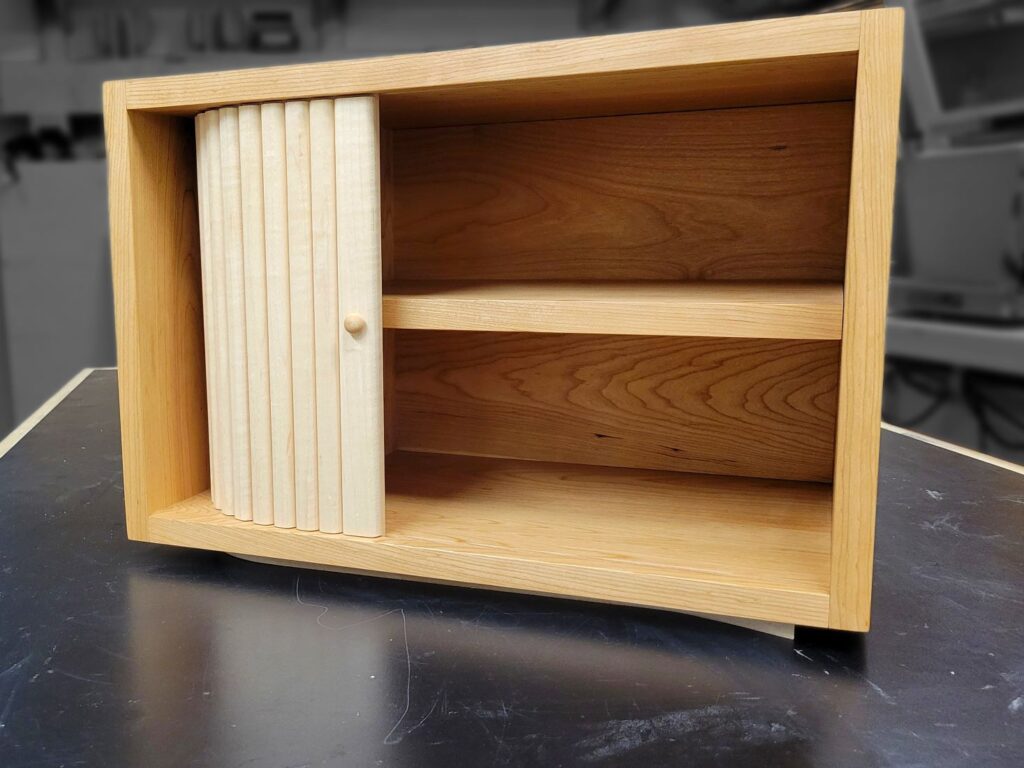
Whenever I’m at a furniture store, I find myself peeking behind the back of pieces or checking under tables, searching for a glimpse of the craftsmanship that went into them. That curiosity is what inspired me to build a tambour cabinet. While designing it from scratch felt daunting, the construction process isn’t as complicated as it seems. It’s built around a straightforward structure: an inner cabinet, a track for the tambour door to slide along, and an outer cabinet to hide the mechanics.
I chose to make this cabinet out of cherry wood, with contrasting maple for the tambour door slats.
After milling the cherry wood to 3/4″ thick, I glued up my panels and cut the 7 parts I’ll need to build the cabinet to size: top, bottom, sides (2), shelf, inner back and inner side panel. The dimensions for each part can be found in the build plans.
Step 2: Creating the Door Track
The next step is to build identical tracks in the top and bottom panels for the tambour door to glide along. This requires precision, so I made a template from MDF, sized to match my bottom panel exactly. Using a compass, I rounded the corners to ensure a smooth track, and then added an exit slot at the back to allow the door to slide in or out once the cabinet is assembled.
With the template ready, I used a quarter-inch spiral bit with a guide bushing in my router, which allowed me to follow the template with precision. I then mirrored this process for the top and bottom panels to create identical tracks, sanding the tracks thoroughly to ensure a smooth glide for the door.
Step 3: Making the Tambour Door
For the tambour door, I wanted a contrasting wood, which I initially thought was ash, though it turned out to be maple. Maple’s tendency to burn when cut at the table saw meant I needed to be cautious. After milling the wood down to half an inch and cutting it to length, I ripped the boards into 5/8-inch strips. Cutting extra strips was essential—some were warped or had burn marks.
To complete the look, I used a round-over bit on the front edges of each slat. I also left one slat slightly wider to attach a door pull later. After rounding, I gave each slat a good sanding to remove any remaining imperfections. Sanding them individually at this stage made the final assembly much easier.
To assemble the tambour door, I built a simple jig to keep all the tambour slats aligned. The jig was made from a piece of plywood with guide rails on all four sides. This ensured my slats stayed aligned and allowed for even spacing. Setting up the jig required careful attention to detail—I used a digital protractor for precise 90-degree angles, though a simple square would work fine, too.
Once the jig was set, I began sliding the slats in one by one, with their rounded edges facing down. After securing the slats, I applied painter’s tape to the top and bottom edges to keep glue off the areas that would ride along the cabinet’s tracks. For the backing, I chose a lightweight canvas to hold the slats together. Using a foam roller, I applied a thin, even layer of glue to prevent any glue from squeezing out between the slats. After pressing down the canvas and adding weights, I let it dry before trimming off the excess canvas with a utility knife.
Step 4: Crafting Rabbets in the Tambour Door
For the tambour door to slide effortlessly, I needed to cut rabbets along the edges of the door. Using a straight router bit, I made a series of passes, carefully adjusting the depth to ensure a clean cut with minimal tear-out. A test fit showed that it worked well, but a minor adjustment made the movement even smoother.
An unexpected discovery was that my initial exit slot didn’t quite allow the tambour to slide as intended, as I had misjudged the bending direction of the door. A quick modification fixed this, and I learned that creating a straight diagonal rather than an S-shaped exit slot would have been a better choice for easy assembly.
Step 5: Assembling the Cabinet Frame
For the frame, I opted for both screws and dowels: screws for hidden sections and dowels for visible, outer areas. The dowel jig helped with alignment, especially for the edge-to-edge panels. To ensure precision, I used two separate drill bits to achieve the correct depths for dowel holes, preventing accidental puncturing through the panels. A dry fit confirmed everything lined up, so I secured the panels with dowels, glue, and a few mallet taps.
Step 6: Applying the Finish
The tambour door remained removable, which allowed me to finish each part separately. Using a hard-wax oil, I applied the finish with a wipe-on, wipe-off technique to avoid drips or runs. This method made it easier to coat the slats individually by simply rolling up the door and creating space between each slat. I carefully applied the finish to the cabinet frame, wiping away any excess to prevent it from clogging the track.
Step 7: Finishing Touches
Once the finished had dried, I could slide the tambour door into the track from the backside of the cabinet. I couldn’t be happier with the results—the tambour door moved smoothly, the contrasting wood added depth, and the finish brought out the character of each piece.
I may have overlooked a final door pull, so for now, a tiny wood knob will have to do. If you’re inspired to try this build yourself, I’ve made the plans available with detailed measurements and tips.
This project taught me that with patience and curiosity, anyone can build something unique and functional. So, if you’re tempted to look beneath a table or behind a cabinet in the future, let that curiosity be the spark for your next project. Thanks for following along, and happy building!
Back by popular demand! Today, I’m excited to share 10 more woodworking basics that every woodworker should know. In a previous video, I covered 15 essentials, and you’ve asked for more—so here we go. If you haven’t seen the first video, I recommend watching that first. Now, let’s dive in!
1. How to Change Any Saw Blade
This might seem basic, but it’s worth covering. When I first started, I avoided changing saw blades as much as possible. The fear of not loosening the blade or tightening it enough—worrying it might fly off—kept me from doing it. Sound familiar? Here are two tips to ease your mind:
Loosening the Blade: Always remember that nuts loosen in the direction the blade rotates. When you question which way to turn, just follow the blade’s rotation direction.
Tightening the Blade: To tighten, go opposite the blade’s rotation. You don’t need to overtighten; the saw’s rotation will help keep the nut secure. A snug fit is all you need. Trust me, you’ll appreciate this tip the next time you need to swap out a blade.
2. How to Find the Center of a Board
Finding the center of a board is something every beginner should know. You could measure and divide by two, but here are a few tricks that make it easier:
Self-Centering Scribe Tool: Simply place a pencil in the tool’s center hole, set the scribe on the board, and twist it until the stops hit the sides. Run it along the board, and voilà—perfect center.
Speed Square Method: For wider boards, use a speed square to draw a line across the width, then draw 45-degree diagonals. Flip the square and draw again—X marks the spot!
Ruler Method: On even wider panels, use a ruler or tape measure, pick two even numbers, and mark the midpoint. Easy, no math needed!
3. Secure Wood Trapped Between the Blade and Fence (or Stop Block)
This might sound odd, but it’s a key tip for avoiding kickback. That piece of wood trapped between the blade and a hard place (i.e. fence, stop block) needs to be held down securely, all while keeping your fingers at a safe distance.
At the Table Saw: When cutting at the table saw, wood trapped between the blade and fence is at risk of kicking back. Always stand slightly off to one side to avoid being in the path of any potential kickback. Push blocks or sticks are great for keeping your fingers safe and holding down the wood to minimize kickback risk.
Patience at the miter saw: When using a miter saw, always wait for the blade to stop spinning before lifting it back up to prevent the blade from catching the wood and causing kickback. Using stop blocks at the miter saw can also lead to kickback, so make sure the piece of wood between the stop block and the blade is held down securely.
Use a Crosscut Sled for Small Parts: For small pieces, use a crosscut sled on the table saw. It provides better support and control, reducing the risk of kickback. I like to use the eraser tip of a pencil as a push stick when cutting small part on a crosscut sled.
4. Prevent Drill Bit Wander
When drilling, the bit might wander from the intended spot. Here’s how to stop that from happening:
Use Brad Point Drill Bits: These bits have a pointy tip that helps prevent wandering.
Use an Awl or Center Punch: An awl makes a small indentation where you want to drill, guiding the bit. For harder surfaces, a center punch works similarly but with more force, ensuring your bit goes exactly where you want it.
5. Milling Lumber—Why & How
Why mill your own lumber instead of buying finished pieces? Here’s why:
Control and Precision: Store-bought lumber may not be perfectly flat or square anymore, especially after sitting for a while. Milling your own lumber gives you control over the quality and dimensions.
Cost Savings: Rough lumber is significantly cheaper than finished lumber. You can save a lot by doing the milling yourself, especially if you need custom sizes or thicker stock.
Milling Process in a Nutshell:
Flatten one face on the jointer.
Flatten one edge on the jointer, making it square to the face previously flattened.
Run the board through the planer to flatten the opposite face.
Trim the final edge on the table saw to square it up.
6. Break Those Perfectly Square Edges
Perfectly square edges might look satisfying, but they’re not practical for furniture. Smooth edges are safer and give a more polished look. Here’s how to break those edges:
Block Plane: Some woodworkers prefer using a small block plane for a more hands-on approach.
Sanding Block: A quick rub with a soft sanding block can soften those edges to a smooth finish.
7. How to Cut Small Parts
Cutting small parts can be tricky and dangerous. Here’s how to do it safely:
Avoid the Miter Saw: Small parts can be dangerous on a miter saw due to lack of support and the risk of kickback.
Use a Crosscut Sled: A compact crosscut sled offers better control and support for small pieces. Hold-down clamps are essential for keeping fingers safe and pieces secure. Alternatively, I like to use the eraser tip of a pencil as a push stick when cutting small part on a crosscut sled.
8. How to Glue Up a Panel
Panel glue-ups can be stressful, but here are some quick tips:
Clamps: Use parallel clamps for even pressure. Don’t overtighten—just snug them up.
Glue Application: Coat one edge fully with glue until you can’t see the grain. Look for small beads of glue squeezing out along the seams.
Alignment: Use small clamps on board ends or clamping cauls to keep boards aligned.
9. Dealing with Glue Squeeze-Out
Glue and stain don’t mix. If glue gets on your wood, it can ruin your stain job. Here’s how to handle squeeze-out:
Wipe It Away: Use a damp rag to wipe away excess glue before it dries. But be careful—too much water can cause swelling.
Wait and Scrape: Let the glue dry, then scrape it off with a chisel or scraper. This minimizes the risk of staining issues later. However, there is a high risk of gouging the wood.
Find the sweet spot: Wait 30-45 minutes for the glue to skin over. Then use a plastic scraper to remove the partially dried glue. This is the cleanest and most effective method that has become my go-to.
10. Cut Factory Ends
It’s easy to assume that the entire length of a freshly purchased board is usable. However, there’s a crucial step that often gets overlooked: cutting the factory ends.
Two Key Reasons to Trim the Ends
Squaring Up the Board: If you place a square at the end of a board, you might be surprised to find that it isn’t perfectly square. To ensure your project comes together accurately, you’ll need to trim the ends of most boards to square them up properly.
Dealing with Checking: Checking refers to the splits or cracks that can develop at the ends of a board as it dries. The ends of a board dry out faster than the middle, leading to these cracks. When you encounter checking, it’s best to cut off the affected area.
There you have it—10 more woodworking basics that will improve your skills and keep you safe in the workshop. If you haven’t already, be sure to check out my first basics video, linked below, for even more tips. Happy woodworking!
Building a Custom Shop Cabinet with Swing-out Shelves and Sliding Doors
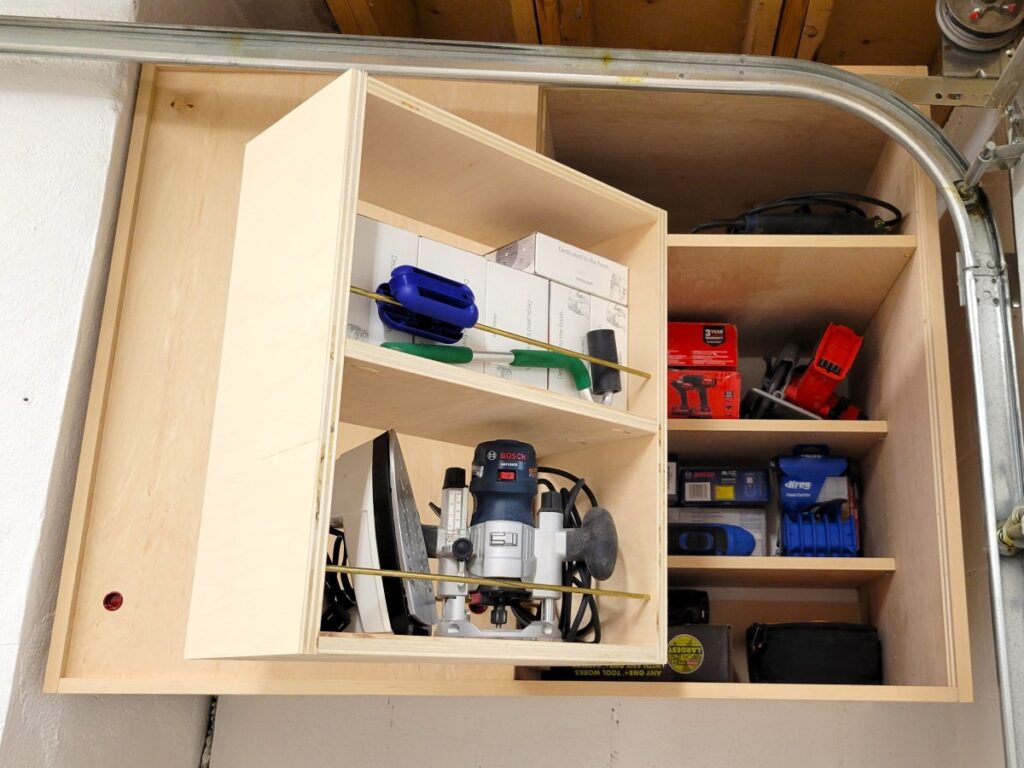
Transforming garage space into an organized haven for tools can be challenging. I recently tackled this by designing and building a unique storage cabinet. This project was born from my need to relocate small power tools from the basement to the garage, maximizing storage with an extra-deep wall cabinet featuring sliding doors and swing-out shelves.
Step-by-Step Process:
1. Breaking Down Plywood: Using ¾ inch maple plywood, I started by having the large sheets cut in half at the store to fit in my SUV. Back in the shop, I used a track saw for initial cuts and a table saw for precise final cuts.
2. Cutting Sliding Door Tracks: I cut tracks into the top, bottom, and sides of the cabinet for the sliding doors using a router table. Ensuring the top track is deeper allows easy installation and removal of doors.
3. Applying Edge Banding: For a polished look, I edge banded all front-facing plywood edges using iron-on edge banding. This step is optional but gives a professional finish.
4. Adding Shelf Pin Holes: Using a jig, I added shelf pin holes for adjustable shelves. Ensuring accurate and consistent spacing is crucial for functionality.
5. Cabinet Assembly: Assembling the cabinet with screws, I used corner clamps to ensure everything was square. I opted for a French cleat system for wall mounting, ensuring a secure and level installation.
6. Installing Swing-Out Shelves: Building swing-out shelves with pocket screws and brass rods, I ensured they would support the weight of tools without sagging.
7. Creating Sliding Doors: Using ½ inch plywood, I crafted the sliding doors, opting for a thickness that balances durability and ease of use. Finger pulls were added for easy opening and closing.
Challenges and Adaptations:
Initially, my design included full-height swing-out shelves, but garage door tracks required a change to sliding doors. Despite the adjustments, the cabinet maximizes storage and accessibility, fitting perfectly above my router table.
Conclusion:
This project highlights the importance of adaptability in DIY woodworking. The result is a highly functional and organized storage solution that fits seamlessly into the garage space. For those interested in replicating this project, detailed plans and a list of tools used are available.
By following these steps and embracing flexibility, you can create custom storage solutions tailored to your space and needs.
In the realm of laser cutting and engraving, the decision to upgrade from a diode laser to a CO2 desktop laser is not one to be taken lightly. Recently, I found myself facing this very dilemma, and after much deliberation, I took the leap. But why? Let’s delve into the journey that led me to this decision.
Why I Upgrade From a Diode Laser Engraver to a Co2 Laser Cutter
About a year ago, I invested in a diode laser, the xTool D1 Pro 20w, spending a significant sum upfront. However, despite my initial excitement, I found myself using it sparingly. Why? Well, as I shared in a previous video, the reality of owning a diode laser came with its fair share of surprises and challenges.
From the unexpected need to build an enclosure and ensure proper ventilation to the steep learning curve of mastering the software and dialing in the right laser settings, I quickly realized that laser ownership wasn’t all smooth sailing. The time-consuming maintenance and the additional costs for accessories only added to the complexity.
Yet, amidst these challenges, I discovered a silver lining. I dedicated time to learning the intricacies of laser operation, particularly mastering Lightburn, and ventured into creating and selling laser-cut plywood templates. As sales gained traction, I found myself increasingly immersed in this side hustle.
Diode Laser Limitations
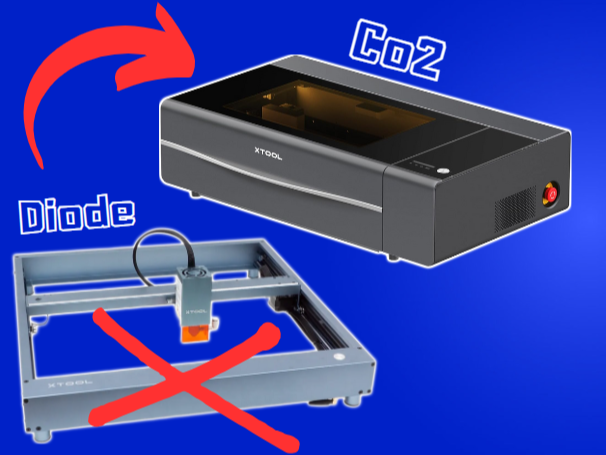
However, the limitations of the diode laser became increasingly apparent. Its slow cutting speed and frequent maintenance demands hindered productivity, leading me to explore alternatives. When xTool offered me a Co2 desktop laser, the xTool P2 55w, I saw it as an opportunity to streamline my workflow and elevate my craft.
Cost: Diode vs. Co2 Lasers
Before diving into the advantages of CO2 lasers, let’s address the elephant in the room: cost. While CO2 lasers come with a higher price tag upfront, the all-inclusive nature of the package mitigates additional expenses associated with diode lasers. With no need for add-on accessories or DIY enclosures, the CO2 laser offers a hassle-free setup.
Co2 Laser Advantages
Moreover, the CO2 laser boasts significant advantages over its diode counterpart. Its faster cutting speed, ability to work with thicker materials, and capability to cut clear acrylic and glass expand the creative possibilities. The built-in features such as air assist, automatic focus adjustment, and a large viewing window enhance user experience and efficiency.
Co2 Laser Drawbacks
Yet, like any tool, CO2 lasers have their drawbacks. They’re heavier and require ample space for installation. Moreover, while they come with built-in exhaust systems, additional ventilation may be necessary to address fume concerns, especially in shared spaces.
Are Co2 Lasers Better Than Diode Lasers?
Ultimately, the decision to upgrade depends on individual needs and preferences. Diode lasers may suffice for hobbyists or those on a tight budget, willing to invest time in setup and maintenance. Conversely, CO2 desktop lasers offer a turnkey solution for professionals seeking enhanced speed, versatility, and ease of use.
Why I Prefer Co2 over Diode Lasers
For me, the choice was clear. The CO2 laser revolutionized my workflow, allowing me to focus on creativity rather than wrestling with technicalities. As I bid farewell to my trusty diode laser, I embrace the new possibilities that lie ahead.
In conclusion, whether you’re a seasoned creator or an aspiring hobbyist, understanding the nuances of laser technology is paramount in making an informed decision. Of course a CO2 laser may seem better, but your specific needs may align better with diode laser technology.
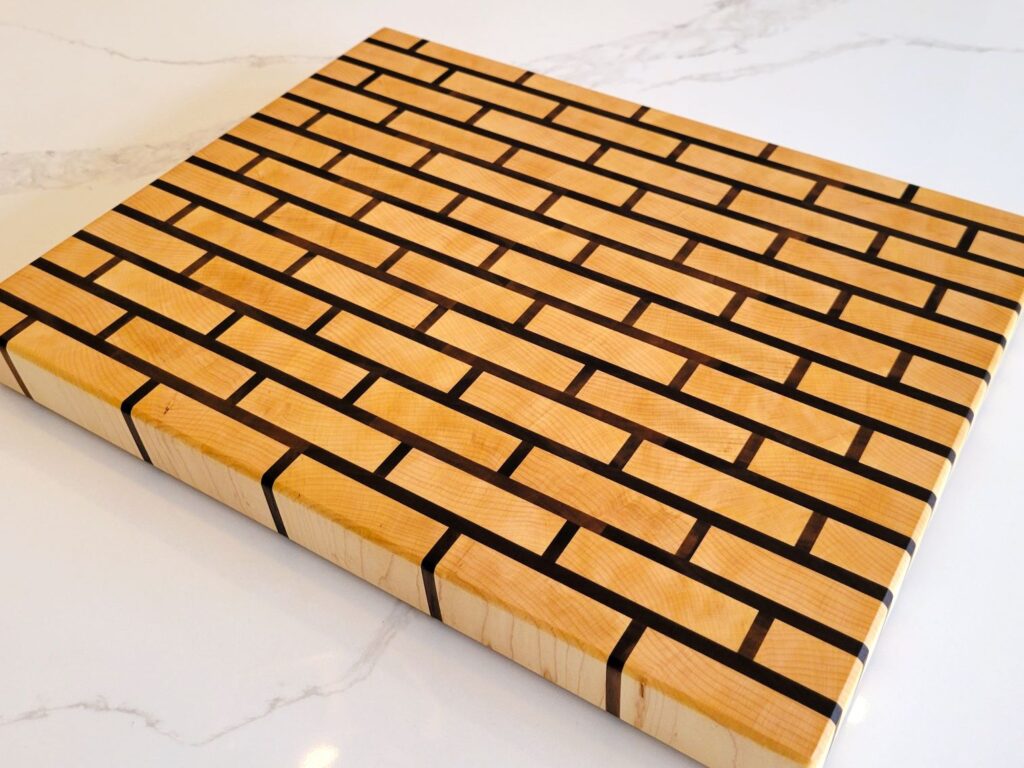
Do you ever wonder what the hype is all about when it comes to end grain cutting boards? Personally, I never got what the big deal was… until I tried to make one myself! Three homemade jigs later, I had a stunning brick pattern end grain cutting board fit for chef.
In this tutorial, I’ll lay out the advantages, challenges, and the step-by-step process of making a brick pattern end grain cutting board.
End grain cutting boards offer more than just aesthetic appeal. They boast self-healing properties, resist knife marks better than traditional cutting boards, maintain knife sharpness, and allegedly have anti-bacterial benefits.
How to Make End Grain Cutting Boards
However, the path to crafting them involves overcoming significant challenges, such as cutting thin strips, dealing with grain direction intricacies (you don’t want to mix end grain and face grain in the same cutting board), and finding alternatives to using a traditional planer.
Milling Lumber:
Opting for a maple and walnut brick pattern, I begin by milling rough lumber and cutting parts to size. I share all the dimensions and cut list in my brick pattern cutting board plans. Click the image below for more info.
Jig #1 – Thin Strip Cutting Jig:
Milling and cutting the parts to size brings me to the first jig we’ll need. Since cutting thin strips on the table saw can be stressful (and dangerous if not done safely), I decided to build a simple thin strip cutting jig.
It’s made up of 3 simple parts: one strip of plywood, one strip of wood that’s the exact same thickness as the board you want to rip into thin strips, and a small block for the handle. See dimensions below.
To use the jig, set your fence to 2 inches + the width of the strip you want to cut. So, if you want to cut 1/4-inch strips, set your table saw fence to 2-1/4.
Thin strip cutting jig dimensions: – 3/4 inch plywood > 24″ x 3-1/2″ – Wood the same thickness as the board you want to cut into thin strips > 24″ x 2″ – Small pine block for the handle > 1-1/2″ x 1-1/2″ x 6″
First Glue-Up – 2 Panels:
Moving on to the glue-up stage, I’ll create two panels. The first will alternate the maple boards and thin walnut strips.
The second panel will be made up of the wider walnut boards. This second panel will be used to cut the walnut end grain strips we’ll need later on. I used Titebond 3 waterproof glue which is ideal for cutting boards, and let the panels dry in the clamps overnight.
Jig #2 – Simple Panel Cutting Sled:
Once the 2 panels are dry, I’ll need to first square up one edge, then rip them into even strips.
To do this, I’ll build a super simple panel cutting sled. Jigs don’t need to be complicated, and that’s what I had in mind when putting together this table saw sled. If you already have a large crosscut sled, you can use that instead.
To make the sled, simple cut a single runner and drop it into your table saw’s miter slot. Drop a plywood base onto it and drill right though the base into the runner to secure it. Trim the edge by pushing the sled though the blade to create a zero clearance edge. Lastly, add a fence at the back of the sled that’s square to the freshly cut edge.
Panel cutting sled dimensions: – Base: 3/4 inch plywood > 24″ x 24″ – Runner: maple > 3/4″ x 3/8″ x 27″ – Back fence: hardwood > 2″ X 1″ x 27″
Cut Panels into Even Strips:
You never want your workpiece to be in contact with the fence as it passes through the blade when using a sled of any kind on the table saw. Instead, I’ll use some double-sided tape to secure a block against the fence well in front of the blade.
With the block in place, I can just slide over my panel until it contacts the small block while making sure it stays square against the sled. Then, push push the sled forward to cut the first strip, and repeat.
When you get towards the end, make sure to use push blocks to help keep the panel from twisting and to protect your hands as you push it through the blade.
Cut both panels into strips.
Resaw Thin End-Grain Strips:
Next, the walnut strips need to be cut into thin end grain strips. You can use a bandsaw then use a drum sander to sand them down to their final thickness, but I don’t have one.
Instead, I’ll use the table saw for this. Ripping 1-3/4 inch thick wood into 1/4 inch strips made me a little nervous, so I was sure to use all the safety precautions, including a featherboard and homemade push block. It’s made from a 2×6 with a sacrificial heel to help hold down the strip and safely push it through the blade.
Final Glue-Up Into Brick Pattern:
With all of my strips now cut, it’s time to glue this up into a brick pattern. First, let’s flip all the walnut/maple strip on edge so that everything facing towards me is end-grain. Then simply rotate every second piece 180 degrees so we start to see that brick pattern forming. This is why the last piece of maple we cut had to be half the size of the others so we would get this offset pattern. And lastly, I’ll insert a strip of walnut between each row. We can now get a preview of what this cutting board will look like.
There are a lot of pieces to glue together, so it’s important to work fast. I worked in small sections, a few strips at a time, applying generous Titebond 3 glue to each piece. I tried to keep one side of the board lined up as I went to maintain the alignment of the brick pattern. Then tighten down the clamps and let it dry overnight.
Jig #3 – Router Flattening Jig:
Now that it’s dry, I need to flatten this board.
You may be tempted to run this through the planer, but I really wouldn’t. You never want to run end grain through a planer. I’ve heard all sorts of stories from tear-out, to boards splitting in half to planers exploding. It’s just not worth the risk. Instead, I’m going to throw together a router flattening jig.
A router flattening sled is easy to make. All you need is a “sled” that’s wide enough to fit your router, with an opening cut in the bottom so the router bit can poke through. You’ll also need 2 rails that the sled with ride along. The rails should be flat, parallel, and perfectly identical.
Router Flattening Sled dimensions: – 3/4 inch plywood > 24″ x 7-5/8″ (base) + 24″ x 2″ (sides – x2) – Pine > 36″ x 2″ (x2)
Final Flattening:
The flattening jig is now ready to use. I’ll start by clamping the rails to my workbench, leaving enough room for the cutting board to fit, plus some extra working room so the bit will have somewhere to go. I cut some spacer blocks using some scraps to fill the gaps on each side and secure the board between the rails.
With a flattening bit mounted in the router, I’ll lower the bit until I hit the board, then lower it just a hair more, about a sixteenth of an inch. You only want to take really shallow passes here, no more than an eighth of an inch. You can repeat the process, going a little deeper for as many passes as you need to fully flatten the board.
Shaping and Finishing:
The shaping and finishing stages involve squaring up the board using the panel sled, adding roundover to all the edges, followed by extensive sanding. Since the board is still pretty rough after using the flattening jig, I’ll start with 60-grit and go over the surface multiple times, moving at a slow even pace. Then work my way up through the grits until 220.
To finish this board, I used TotalBoat Wood Honey. It’s a food-safe mix of oils and waxes. I started using this finish recently on my router bowls and just love how easy it is to use and the amber finish it gives the wood. It really makes the colors pop.
By the way, you can get 5% off all TotalBoat products by using this link.
Conclusion:
As it turns out, making your first end grain cutting board is a lot of work, but a really fun challenge! I totally get it now, and feel really proud of this build. Once you’ve got the right jigs, you can really start making these faster and get creative with your designs.
Just a reminder that I have plans available for this brick pattern end grain cutting board. Grab them here.
It’s that time of year! My annual holiday gift making video. Here are 5 new ideas for holiday gifts you can make from wood.
For the step-by-step process for making these 5 woodworking gifts you can make from wood, watch the YouTube video below.
5 Woodworking Gifts You Can Make
Woodworking Gift Idea #1: Kitchen Tongs
To make these kitchen tongs, you’ll need 2 thin strips and a block of hardwood of your choice. I used maple. The starting dimensions of the two strips are 9 x 1-1/8 x 1/8, while the block is 2 x 1-1/8 x 3/4.
The key is the small connector block. Using an angle of 87.5 degrees, trace a tapered shape that is narrow at the top and wider at the bottom. The bottom should measure roughly 5/8 wide. Cut or sand the block up to the lines the create the tapered shape.
Before assembly, you can round one end of both strips. Then apply glue to the tapered block and glue up the tongs. For both strength and visual detail, I added 3 walnut splines and rounded the end of the handle. Finish by sanding and adding a food-safe finish.
Woodworking Gift Idea #2: Soma Cube
To make the Soma cube, you’ll need 27 identical blocks, each shaped in a perfect cube. I used cherry wood that was just a hair under 1x1x1, but you can use any size you want. They just have to be perfect cubes!
Glue them up into the 7 shapes shown below. I used regular wood glue and some painter’s tape to hold them together while they dried.
Apply a finish and, if you’re so inclined, build a small box to store them. The idea is to figure out how to fit the shapes together to form a perfect cube. Need a hint to figure it out? You’ll find the solution to the Soma Cube Puzzle here in the video.
Woodworking Gift Idea #3: Phone Dock / Amplifier
To make this phone dock, start with 4 thin panels (about 1/4 inch thick) measuring 9 inches by 3 inches.
Miter the edges of the panels and assemble them into a cube. Next, shape the cube by cutting off each end on an angle and cutting a slot for the phone. The angle of all the cuts is 33 degrees.
The final dimensions of this phone dock / amplifier are 2-1/2 x 2/-1/2 x 8. The slot for the phone was cut approximately 2 inches from the front edge and made just wide enough to fit my phone with its case. I used maple and walnut.
Woodworking Gift Idea #4: Bear Claw Salad Servers
To make these bear claw salad servers, start with 2 blocks of wood (I used Cherry) measuring roughly 8 x 4-1/2 x 1.
Print the templates and secure them using some light-duty spray adhesive. Starting with the profile template first, cut out the shape using a bandsaw. Then sand to smooth the face before securing the second template. Cut the claw shape out at the bandsaw. Then sand everything smooth and apply a food-safe finish.
Woodworking Gift Idea #5: House Shaped Coin Bank
A piggy bank is a great gift to make for you kids. Instead of being shaped like a pig, my coin bank is designed to look like a little house.
You’ll need 4 pieces of 3/4-inch plywood cut to 8-1/2 x 11 (same as a sheet of paper). Start by gluing together 2 of the pieces, then use some light-duty spray adhesive to stick down the inner template which will allow you to cut away the inside of the coin bank where the money will go. When making the cut on the bandsaw, make sure to enter and exit from the top of the chimney as this will become the coin slot.
Next, sandwich the 2 first pieces in between the 2 other pieces of plywood and glue them all together. Secure the outer template and cut the shape on the bandsaw to create the house.
Sand the house and paint on some decorative finish if you’d like. Don’t forgot to drill a hole into the bottom using a Forstner bit and add a tapered cork plug (large enough to fit the biggest coin in your local currency) so kids can get the money out when the time comes!
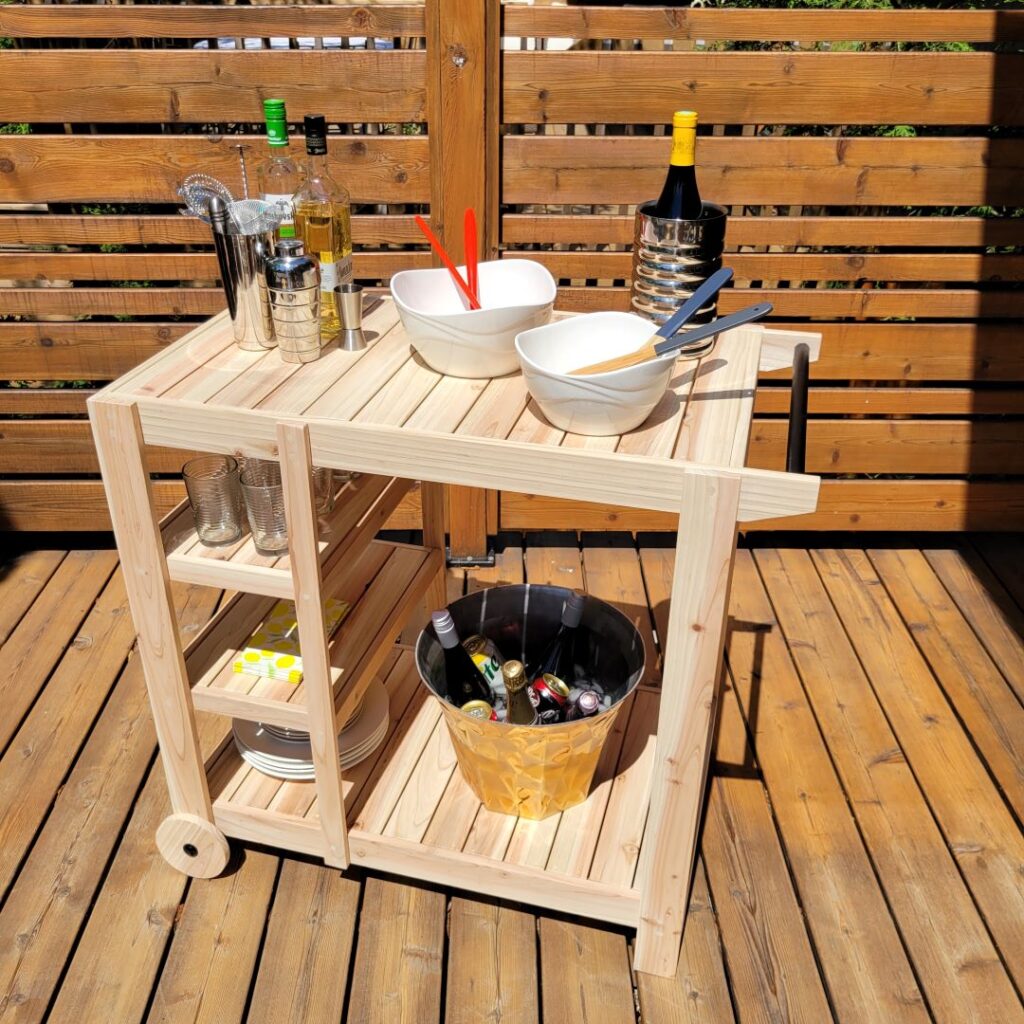
In this blog post, we’ll guide you through the process of building a beautiful and functional outdoor serving cart or bar cart using cedar fence boards. Cedar is an excellent choice for outdoor projects due to its weather and rot resistance. We’ll also share some valuable tips and tricks to make your project a success.
Start by choosing straight and high-quality cedar fence boards. Cedar’s natural resistance to weather and rot makes it perfect for outdoor furniture. Ensure that the boards are as straight as possible for a smoother construction process.
2. Squaring the Edges
To ensure your boards have square edges, shave off one edge using a table saw. Safety is paramount, so always use a blade guard and additional support like a roller stand to handle the boards effectively. A featherboard helps maintain consistent width cuts.
3. Cutting and Labeling Parts
Use a miter saw to cut the boards to length according to the dimensions in the plans. Using a stop block ensures that all mirrored parts are precisely the same length. Label your parts as you cut to prevent confusion during assembly.
4. Adding a Chamfer
Before assembly, add a slight chamfer to the board edges. Chamfering not only enhances the appearance but also provides a more professional finish. You can use a router table or a handheld trim router for this purpose.
5. Bottom Shelf Assembly
Assemble the bottom shelf section by adding a cleat to support the slats. Use waterproof wood glue suitable for outdoor use. Ensure proper spacing between slats and secure with exterior-grade screws.
6. Top Shelf Construction
Construct the top shelf with tapered ends and a round handlebar. Cut the taper using a flush trim saw and create shallow holes for the handlebar using a drill press. Stain the handlebar with India ink for a sleek black finish.
7. Concealing Screw Holes
To hide screw holes cleanly, use a plug cutter to create plugs from poplar wood. Fill the holes with glue, tap in the plugs, and trim them with a flush trim saw. Sand lightly for a seamless finish.
8. Cart Assembly
Assemble the cart section by section, starting with the sides. Use spacer blocks to ensure proper alignment and drill countersink pilot holes before securing with screws. Check for squareness using a speed square.
9. Adding Middle Legs
Install middle legs to support the small shelves. Again, use spacer blocks for alignment and secure with glue and screws.
10. Plug screw holes
Cut some plugs using a plug cutter then pop them out using the bandsaw for a faster process. Fill any imperfections with glue and sawdust, then sand flush to achieve a perfect finish.
11. Attaching Wheels
Cut 5-inch wheels using a bandsaw circle cutting jig and install them with carriage bolts. Remember to add washers between the wheel and the leg for stability.
12. Final Touches
After completing all these steps, you’ll have a mobile outdoor serving cart ready for your summer gatherings. Solve your space issues during barbecues and enjoy the convenience of this beautiful cedar cart.
Building your own cedar outdoor serving cart is a rewarding DIY project. By following these steps and incorporating some clever tricks, you can create a sturdy, functional, and attractive addition to your outdoor space. Don’t forget to check out the plans for this fantastic project. Happy building!
Around nine months ago, I made an impulsive purchase—an xTool D1 Pro 20w laser engraver. At first, the idea of creating custom designs and engraving on various materials excited me. However, my initial enthusiasm soon waned, and the laser engraver ended up gathering dust in the corner of my basement.
In this blog post, I’ll share my experiences, the challenges I faced, and the six things I wish I knew before buying a laser engraver.
Everything You Need to Know Before Buying a Laser Engraver
1. Dealing with Fumes and Exhaust
One of the most significant surprises was the overwhelming smell and toxic fumes produced by the laser engraver. I learned the hard way that proper ventilation and an enclosed workspace were essential for safe usage. Setting up an enclosure with an inline duct fan proved to be crucial, as it effectively extracted fumes and kept my basement free from toxic odors.
2. The Hidden Costs of Laser Ownership
The initial cost of the laser engraver was just the tip of the iceberg. Additional accessories, such as a honeycomb grid for cleaner cuts and an air assist pump for better engraving, were necessary but not included in the original price. Moreover, setting up an efficient exhaust system required investing in an inline duct fan, hosing, and flanges, further adding to the expenses.
3. The Limitations of Laser Types
I failed to realize that not all laser engravers are created equal. The diode laser I purchased could not cut clear acrylic, limiting its capabilities. Understanding the differences between CO2, fiber, and diode lasers is vital to ensure you get the right tool for your specific needs.
4. The Time-Consuming Nature of Laser Work
Using a laser engraver is not as straightforward as pressing a button and walking away. It requires constant supervision, as the potential for fire or mishaps is ever-present. Additionally, learning the intricacies of the laser engraving software and adjusting settings for the best results can be time-consuming.
5. Learning Curve and Software Updates
Becoming proficient in laser engraving involves a steep learning curve. You need to master design software and the intricacies of the laser’s settings to achieve optimal results. Software updates and glitches are also common challenges that require patience and research to resolve.
6. Trial and Error: The Key to Success
Don’t expect perfection from the start. Trial and error is the name of the game with laser engraving. Experimenting with different materials, settings, and techniques is the best way to improve your skills and achieve better results.
Conclusion
Though my initial experience with the laser engraver left me feeling disappointed, I now realize that my journey has just begun. Learning from my mistakes and embracing the learning curve, I’m determined to unlock the full potential of this powerful tool. In fact, I’ve already started designing and selling router templates that you can check out in my online store.
So, if you’re considering buying a laser engraver, be prepared for the challenges, invest time in learning, and don’t give up too soon. With patience and perseverance, you can transform your laser engraver into a powerful creative asset, unleashing endless possibilities for customization and artistic expression.
A couple years ago I built a hexagon cutting jig that’s adjustable and can cut out hexagons any size. I have plans available for the hexagon jig, but I get a lot of requests for either a pentagon jig or an octagon jig.
Instead of building a dedicated jig for each shape, I’m building a polygon cutting jig. With this jig, you can cut any shape you want! Cut a pentagon, hexagon, octagon or even a heptagon. Could this be the jig that does it all?
If you’re interested in building this polygon cutting jig yourself, I’ve got builds plans available. Click on the image below for more info.
Polygon Cutting Jig
In woodworking, precision is key. That’s why having the right tools and jigs can make all the difference in achieving accurate cuts and shapes. In this blog post, we’ll take a look at how to build a jig for cutting polygons.
Base and Runners
To begin, start by cutting a roughly square piece of ¾ inch plywood for the base of the sled. Once you have the base, it’s time to add runners that will slide through the miter slots on the table saw. While hardwood runners are an option, we recommend using plastic runners made from a low friction plastic called UHMW. These runners provide a perfect fit for the miter slots and glide smoothly without any side-to-side play.
To ensure that the runners stick to the bottom of the sled, place some nickels in the miter slots, and then add a few dabs of super glue to each runner before placing the plywood base onto the runners. After pressing down for about 45 seconds, gently pull up the sled. Use clamps to keep the runners secure while you drill countersink pilot holes.
Once the pilot holes are in place, secure the runners with small screws, making sure that the heads are sunk beneath the surface. Be gentle when tightening the screws to avoid overtightening, which may cause the runners to expand and not glide smoothly in the miter slot.
After attaching the runners, test the sled to see how it glides through the miter slots. If you find any friction points, sand down those spots, and repeat the process until the sled slides smoothly. Adding a little paste wax on the table and on the bottom side of the sled can help to reduce friction.
Next, you can cut a partial kerf that doesn’t compromise the sled’s integrity.
T-tracks
Once you have the kerf, add T-tracks to the sled at specific intervals that will allow you to position and lock down adjustable fences at different angles as needed. Mark where the tracks need to go and add reminders as to which side the track goes on so that you do not make any mistakes.
To sink the tracks into the sled, flush with the surface, use a router with a ¾ inch straight bit. To figure out your router setup, grab a scrap piece of plywood and clamp a fence to it. Then run the router along the fence and make a shallow pass. Measure the distance between the fence and the track and set the guide for your router. Use this setup to make a dado using three passes, lowering the bit by an eighth of an inch on each pass. On the final pass, set the bit’s thickness to the track or slightly deeper, so the track sits flush below the surface.
Secure the T-tracks into the slots with 5-minute epoxy. Weldbond glue is another option that holds up well. The tight fit of the tracks might require knocking them in to ensure that they are flush beneath the surface. Clamping a dowel across the track helps to apply even pressure while it dries.
Adjustable Fences
Moving on, the adjustable fences are made from hardwood and can be shaped using a router table with a quarter inch spiral bit that is ideal for plunging. A piece of tape can be used to mark a start and stop line about an inch away from the bit on each side. The board is then lowered onto the spinning bit while keeping the end of the board lined up with the start line. Push the board all the way through until the other end of the board reaches the stop line. Flip over the board, keeping the same edge against the fence and repeat. In the end, you should be left with a perfectly shaped slot.
Once the slots are cut, a small chamfer is added on the bottom side to allow sawdust to escape while using the jig. One corner of the shorter piece is also cut off to make the use of the jig easier.
To assemble the jig, four T-bolts are inserted into the T-tracks. You can then drop on the adjustable fences, then add washers and star knobs to lock them down.
Using the Polygon Cutting Jig
Using the jig requires a digital protractor to dial in the angles perfectly. A cheat sheet for all the polygon angles is provided below as a reference. For any other regular polygon with X sides: (X-2)*180/X = angle.
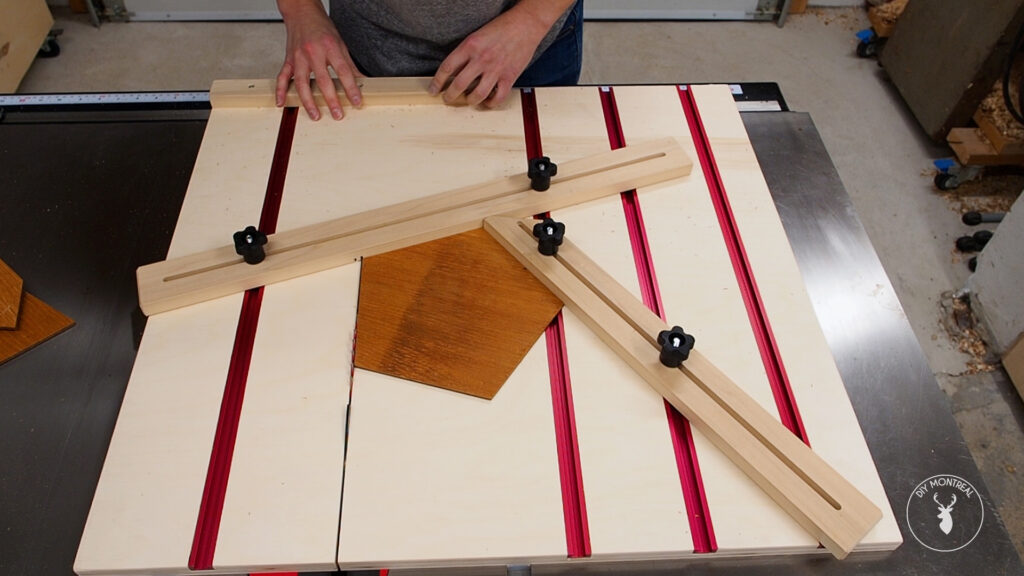
For example, to cut a pentagon, you’ll want to set the protractor to 108 degrees. The long back fence is set up first by placing one edge against the left side of the blade, and then gently butting the fence up against the other side and locking it down. The second angle is set using the first fence as a reference.
To cut the pentagon, make a first cut using only the back fence to establish the reference angle. Now the piece can be easily nested up against both fences to make the next cut. Rotate the piece and repeat until all sides are cut and you’re left with a perfect polygon.
In conclusion, this jig is a great tool for woodworking enthusiasts who want to create precise and consistent polygons in their projects. With a little bit of effort and the right tools, anyone can build and use this jig for their projects and cut precise geometric shapes out of wood with ease.
I get a lot of pushback because of the fact that I use entry-level drills. You’ll either see me using a Ryobi drill or a Craftsman drill, and frankly I’m happy with them. They do the job I need them to do, and they didn’t break the bank.
I didn’t choose these drills because I’m cheap. I invest in plenty of tools when I think the added features are worth the cost. But when it comes to drills, I just don’t believe that more expensive is better.
Am I wrong? Well, today I’m putting some of the most popular brands to the test to find out. And I can tell you now, you’ll be surprised by the results!
Are more expensive drills really worth it?
Going into this test, I honestly believed that there would be little difference between the performance of the more expensive drills and the less expensive drills. Well, I was wrong. That said, the most expensive drills didn’t necessarily do the best, and there were some surprises for one of the underdogs too!
Choosing Which Drills to Test
To pick out which drills to include in this test, I first did some online research. I came across articles like CNET’s Best Cordless Drill of 2023 and The Spruce’s 12 Best Cordless Drills of 2023. I wasn’t surprised see DeWalt and Milwaukee drills at the top of these lists.
The more I read these “top drills of 2023” articles, the more confused I got. The specs on the drills being tested were all over the place. Comparing 12v to 18v drills, brushed and brushless motors, and some with hammer drill settings. It just didn’t seem like they were comparing apples to apples.
With that in mind, I set the drill inclusion criteria as follows:
18v or 20v (no 12v)
1/2-inch chuck (vs. 3/8 chuck on less powerful drills)
Brushed motor (for the cheaper drills) OR brushless motor (for mid-to-high-end drills)
As I mentioned before, the goal here isn’t to find the best drill of 2023. The question here is Are more expensive drills really better? With that in mind, here is the drill lineup I chose to include in the testing.
On the low end of the scale both coming in at $99 (BTW these prices are in Canadian dollars), we have the Ryobi 18v and the Craftsman v20. These are actually the same drills I happen to use in my shop on a regular basis (but these ones are brand new). These both have brushed motors.
In the low-to-mid-range at $149 we have a Ridgid 18v drill with added value supposedly being its brushless motor and sub-compact design. It also comes with two (2) 2.0 Ah batteries which is a step up from the 1.3 and 1.5 Ah batteries that come with the Craftsman and Ryobi drills.
In the mid-to-high-range we have the extremely popular DeWalt drill. This one is the DeWalt 20v MAX XR. It has a brushless motor, comes with two (2) 2.0 Ah batteries and sells for $259. The specs (torque & RPM) on this DeWalt drill are neck above the others, as you can see in the table further down.
The Milwaukee M18 is very comparable to the DeWalt with a slightly higher price point at $288. It’s a compact brushless 18v drill that features the same brushless motor and comes with two (2) 2.0 Ah batteries.
And last but not least, on the high end of the spectrum (some would even say premium) I decided to include theFestool T18+3 which seems to be popular among woodworkers and carpenters. The tool alone is $425 or a whopping $739 for the kit with (2) 4.0 Ah batteries and a charger. It’s of course got a brushless motor and is the only one to come with 2 different chucks. A standard one for drilling and a quick change Centrotec chuck for driving screws.
So here’s a summary of our drill lineup:
How I’ll Test the Drills
Let me first get this out of the way. Every tool I’m testing is brand new with brand new batteries (all paid with my own money – this post is not sponsored in any way). I started with a full charge for every test I ran, and also used a new drill/driver bit for each tool tested.
So will I test these drills?
First I’ll evaluate the obvious physical features of each: weight, overall size and clearance required, grip/comfort, ease of use, LED light, as well as the official specs listed on the package (speed & torque).
Next I’ll subject each of these to various stress-tests to evaluate the speed, torque, power and longevity of each drill. I’ll drill a bunch of holes and drive a bunch of screws, and tally up all the results.
Test #1 – Speed Drilling – How long will it take to drill 10 holes using a 1″ paddle bit?
Test #2 – Driving screws until the battery runs out – How long does the battery last on a single change?
Test #3 – Timed Lag Screw Test – How many leg screws can be driven in 30 seconds?
If you want to see how each drill performed (spoiler alert: one of them started smoking!) be sure to watch the YouTube video.
Best Drill of 2023
Okay, so I finally get it. I’ve been living in the dark ages this whole time with my Ryobi and Craftsman drills. As you can see by the specs and performance of each drill in the table above, the difference between these drills and the more expensive ones is clear. I mean, there’s no way you could work in the trades using an entry-level drill. They’re just not powerful enough.
That being said, I don’t have the same needs as an electrician or plumber or deck builder. I only use drills on occasion to drill pilot holes and drive a few screws. Do I like the high-end drills better than the ones I have? Yeah, for sure! But do I need them? Not necessarily…
Don’t worry, I’m not going to be one of those people who does a review and then doesn’t name a clear winner. I will say it depends on your needs but if I were to pick one of these drills to use in my shop from here on out, it would have to be either Milwaukee or Dewalt. I think both are strong contenders and have their minor advantages and drawbacks at similar price points.
The specs on DeWalt take the cake, but they’re almost overkill, causing potential wrist injuries. I do however like the oversized LED, with a switch to control it. It is a tad heavier than Milwaukee though, so again, minor trade offs. I think ultimately I’d have to look at the entire tool line-up for both brands and decide which tool line I’d rather buy into for the long run.
As far as the other drills go…
Festool is indeed in a league of its own. So powerful and smooth. But it didn’t always perform the best overall. Its torque is actually slightlyunderwhelming. It’s also the heaviest and one of the biggest drills I tested, which is a big turnoff for me. And the price tag is way too high. So Festool is a pass for me.
Ridgid was a pleasant surprise though. It performed fairly well overall given its price point and probably the best value for money in my book.
Craftsman performed the worst overall and Ryobi didn’t do much better, as I’m sure most people won’t be surprised to hear. They lacked speed and power in most tests, and they’re bigger and clunkier than most competitors.
That said, a drill is usually just the gateway to the entire line of tools. I’ve always liked that Ryobi and Craftsman have a whole line of entry level tools that run on the same batteries, and I already own many of these tools. So is the added value of the DeWalt or Milwaukee drill enough to make me want to switch everything over? I’m not so sure.
But to answer the question: are more expensive drills really worth it?Absolutely. The high end drills definitely pack more power than the entry-level drills. As they say, you get what you pay for.
The simplest jigs are always the best ones. Today I’ll show you how to make 5 super simple woodworking jigs that’ll make your life easier. No fuss, easy to make jigs that can be assembled in minutes using scrap wood.
How to cut thin strips on the table saw? Easiest way to hang a picture frame? Making straight cuts with a circular saw? How about safer cuts on the table saw? How to get the perfect sized dado? All these questions and more will be answered.
5 Super Simple Woodworking Jigs
Today I’m going to show you 5 basic jigs you can make in just a few minutes. Nothing fancy. Nothing complicated. The idea is to keep these as simplistic as possible but of course you can add all the bells and whistles you want to make these jigs even more awesome.
1. Thin Strip Cutting Jig
Dimensions: 3/4 plywood – 20″ x 3-1/2″ & 20″ x 2″ 1×2 pine block roughly 5 inches long 1/4 plywood roughly 2″ x 5″
Cutting thin strips on the table saw can be nerve wracking and downright dangerous if you’re not careful. It becomes difficult to effectively push the stock past the blade and kickback can easily occur.
There are a few ways to make this type of cut safer, one being to use a push block. I’ll use this to cut half inch strips, but when I want to cut something as thin as one eight of an inch, I get a little nervous and often worry I’ll put the blade through the tool. The leg is replaceable, but it’s enough to startle someone which is never a good thing when using the table saw.
Another option is to use a physical reference like a Magswitch that you set to the outside of the blade. Once set up, you can batch out multiple strips of the same exact thickness. It’s a pretty practical tool. Once in position, just turn the knob to activate the magnet and it’s locked in place. I do like the safety of this method, but the drawback is that you constantly have to adjust your fence on every cut, which can be a bit finicky to get it just right.
A third option is to build a simple jig. All you need is a strip of plywood, a block for the handle, and a thin strip for the heel. I’m keeping this jig super basic, nothing fancy. I’ll simply screw the wooden block that will act as a handle to the strip of plywood. I’ll first create a temporary bond to hold it in place using some CA glue and activator. I can then flip it over and screw it down after first drilling some pilot holes using a countersink bit.
For the heel, I have a random thin strip of wood I picked out of my scrap pile but you can use a thin piece of plywood instead. I’ll secure it to the back end making sure to offset it just a bit so it won’t interfere with the fence. Again, countersink hole first so I can then easily screw it in, flush with the bottom side of the jig. Notice that the heel extends past the jig to the left, which is what you want.
Okay so let’s try it out. I know that my plywood is exactly 3-½ inches wide, so I’ll set my fence to 3-½ PLUS one eighth of an inch because I want to cut one eight strips of wood. So now you can see I’ve got a narrow gap between the jig and the blade.
Note that I’m cutting fairly long strips so there’s no chance they’ll fall into the opening around the blade but if you’re cutting short strips you should seal it up with painter’s tape.
After a few passes, I could clearly see it works. I’m getting thin, even strips. But I’m still feeling a little bit nervous that I’ll experience some unexpected kickback, so I think I can make this jig a little safer.
I’ve got another strip of plywood here – same length but ripped to exactly 2-inches wide – and I’m going to add it underneath the jig. The key thing to point out here is that the piece I’m adding has to be the same thickness as the stock you want to cut.
Now I want this to be flush to the fence so I’ll flip it on its side and clamp it, then simply secure it with a few screws.
I’ll also replace the heel with a slightly bigger piece. Again, I just want it to cover the entire back side and extend past a few inches to the left.
Okay, let’s test it out. I’m making sure my blade isn’t too high, just the tips poking up above my workpiece. I’ll set the fence to 2-1/8 (2 inches is the width of the jig and 1/8 for the width of the strips I want to cut).
Wow, this feels much better. I feel safe and in control with the jig essentially covering the blade and the workpiece. Plus, I barely have to push through the workpiece with my other hand, just letting the heel and the jig do most of the work. I love it! Definitely a safe and easy way to batch out even thin strips.
2. Adjustable Dado Jig
Dimensions (3/4 plywood) 2 @ 24″ x 5″ >> Cut groove starting 1″ from each end, roughly 1/2″ wide and 1/4″ deep, then drill through center using 5/16 bit (to match size of T-bolts) 2 @ 11″ x 2-1/2″ >> Drill holes 2-1/2″ from each end on center using 5/16 bit
Dados can be super practical in so many applications. Typically if I wanted to make a dado, say for a bookcase, I’d draw a reference line, then grab a 3/4-inch straight bit and set it in my router. Then clamp a guide rail down and run the router against the guide. And voilà, we have a dado.
The problem you’ll often run into doing it this way is that the dado is the wrong size. Here you can see that the joint isn’t tight and there’s actually a noticeable gap you can see here. That’s definitely not what I want when making a dado.
The problem is that most 3/4-inch plywood isn’t actually 3/4 inches thick. They actually sell “undersized plywood bits” that are 23/32nds. This bit works great when your plywood is exactly 23/32nds, but that isn’t always the case.
So, today I’m going to build a pretty simple adjustable dado jig. I’ve seen all sorts of dado jigs but I’m going to try something a little different and I hope it works out.
I’ll cut 4 strips (see dimensions above), then connect them using T-bolts and star knobs. But the first thing I want to do is create a track for the T-bolts so they don’t spin endlessly as I tighten the knobs. Here I’m measuring the width of the T-bolt but it doesn’t have to be a tight fit, it can have a little wiggle room, so I’ll go with about half an inch wide.
I’ll lower my blade to about a quarter inch and set a stop so I can make consistent grooves at each end of both of my pieces. I can then just nudge the board over to widen the groove progressively. I’ll stop about midway then adjust the stop to mark the opposite side of the groove for all my cuts. Then remove the stop and nudge over the board until the groove is complete.
Okay so my 4 grooves are cut and I can do a quick test to see that my T-bolt fits nicely – like I said, just a hair wider than the T-bolt so it fits effortlessly. Next, I’m going to drill some holes right in the center of the grooves to fit the T-bolt through. I’m using a 5/16 bit to match the size of the T-bolts. And I’ll drill holes in the smaller pieces using the same bit.
Okay, so that’s pretty much it. Now I can assemble it and it’s ready to use. Just slip the T-bolt into the tracks from underneath, then add the shorter piece of wood to connect both sides and add a washer and star knob to each bolt.
As you can see here, by moving the pieces, you can adjust the size of the slot in the middle depending on the size dado you need. The easiest way to set it up is to grab the piece you want to make a dado for and drop it in, then adjust the jig to its snug but not too tight, then tighten down the knobs.
Now just carry the jig over to your workpiece, line it up with your reference line, and clamp it down. Then drop in your router. You’ll need a half inch pattern bit with a top bearing so the bearing can ride along the jig. Lower the bit so it pokes out by about 1/8th and lock it down.
You want to go around in a clockwise direction, starting on one side then over to the next. I’ll then lower the bit and go around again. Ok, let’s test this out. I mean yep, perfectly snug without being too tight. So with jig there’s no more guesswork. You get the perfect dado every time.
3. Circular Saw Guide
Dimensions (3/4 or 1/2 plywood) 48″ x 10″ 48″ x 2-1/2″
I’ll be honest: I don’t care much for circular saws and rarely use them. I find it challenging to line up the cut and get a straight clean cut. Not to mention actually cut on the line.
Instead you’ll see me using a track saw which is amazing for getting precise clean cuts in sheet goods. But a track saw can also be expensive and not in everyone’s budget, especially if you only use it on occasion.
But the good news is that you can turn pretty much any circular saw into a track saw by making a super simple guide rail. You can make it any length you want according to your needs, but I find the 3 to 4 foot length to be ideal. You’ll want a strip roughly 10 inches wide and the other roughly 2 to 3 inches wide.
Next, grab your saw and flip it over to get a rough measurement of the distance between the edge of the base plate and the blade. It doesn’t have to be exact, but just a rough idea.
Then add a half inch or so to that measurement and mark that onto the bigger board. You want to make sure the reference edge here is the side the saw blade will be on, depending if your saw is blade-right or blade-left.
Add a little glue and clamp the other piece down right up against the line. Then grab some flat head screws and screw it down after first making some countersink pilot holes.
All that’s left now is to cut the edge to make a zero clearance edge which will really help you get clean and precise cuts. As you can see the jig is pretty simple. The key is to leave enough room on the opposite side of the base so you can clamp the track down without getting in the way of the motor. And as you can see, I have a little excess material on the blade side that I’ll trim away for the perfect zero clearance base.
To avoid tearout, set the jig on some scrap wood for this. Then set the height of the blade so the tip of the teeth are just poking down underneath. Then make the cut, making sure the base plate is pressed up against the fence throughout the entire cut.
And with that, the jig is ready to use, so let’s try it out. Remember to always support your cuts to prevent pinching of the blade. I’ll trace where I want to make the cut, then line up the edge of the track on the line, and clamp it down. Then just let the saw glide along the track keeping it snug against the fence. And voilà. A perfect clean, precise and perfectly square cut.
4. Vertical Cutting Jig for The Table Saw
Dimensions (3/4 plywood) 12″ x 10″ 12″ x width of table saw’s fence 12″ x (height of table saw’s fence + 3/4″)
This next jig is super easy to make and oh-so-versatile. Some people call it a tenoning jig, but it can do more than that. You only need 3 pieces of plywood for this. The idea is to assemble a frame sort of like this that will ride along the table saw’s fence. It needs to be snug around the fence, so I’ll measure the width of the fence – mine’s about 4 inches – and rip this piece to size.
This outside piece doesn’t need to be this tall either, so I’ll trim it down a bit. There, that’s good. A quick check to see that it’s not too tight. Looking good. So here’s the basic structure of the jig. Next I’ll clamp it together so I can assemble it with some screws.
Ok, the last step is to add a vertical piece that will act as a backstop and support your workpiece as you push the jig through the blade. You want this piece to be perfectly square so I’ll use a speed square to position it, then clamp it down. I also recommend adding a handle of some sort; I just screwed on a block of wood.
Alright, slides smoothly. You can also add a coat of paste wax if needed to help it slide better along the fence.
So like I said, this vertical cutting jig can be used for cutting tenons, but if I’m honest I’ve never built anything using mortise and tenon. Still, there comes a time when you might need to make a notch in the end of a board, like when I made a flip top planer/sander cart. This is the perfect way to make that cut. It’s also great for cutting bridle joints, if you’re into that sort of thing.
Or say you want to cut an aggressive edge on a board, like if you’re making a pizza peel. Just tilt your blade, clamp your board vertically to the jig and run it through.
I built a similar jig for making castle joints for a coffee table. But I made it a lot taller and more robust to support the beefy 4×4 posts I was cutting. By adding a second horizontal support, it’s much more stable. You can also make a hole through the vertical face or cut away a portion like I did here to make it easier to clamp your piece in place. The beauty of these jigs is how easy they are to make so you can easily throw one together for whatever your needs may be.
5. Keyhole Slot Jig
Dimensions (1×2 pine or poplar) 2 @ 3-1/2″ (or width of router base plate) 3 @ 7-1/4″ (or width of router base plate + 2x width of the wood + 3/4″)
This is a keyhole router bit. It’s a super easy way to hang things flat against the wall. I used it for this wine rack I made and several picture frames too. But without some sort of jig, it can be tricky to use. Actually I’m not really sure how you would use this without a jig.
Anyhow, I’ll show you how to make a super simple jig in no time. First you’ll want to measure your router’s base plate. If it’s round, just measure the max width. The idea is then to build a box around the base with a little wiggle room on one side.
I’ll grab a strip of 1×2 pine from my lumber cart and cut 5 pieces. 2 @ 3-½ inches – which is the width of my router plate, and 3 @ 7-¼ inches – which is the width of my router plate, plus twice the width of my wood, plus ¾ inch of wiggle room.
Next I simply need to assemble the parts like so. You can use whatever method you want- I’m just going to screw it together but I’ll first drill pilot holes using a countersink bit to prevent splitting.
Then I’ll line up the edges and clamp it together so nothing will move while I drive in the screws.
Voilà. A quick check to make sure the router actually fits – ok all good. Last step is to attach this piece that will act as a reference against the top edge of whatever you’re trying to make keyhole slots into. Just make sure it’s flush and secure it. I’m using nails for now so I can show you an alternative later, but you can screw it down too. I like to trace a center line at the top which will make it easier to use.
So let’s say I want to hang this plaque on the wall. I’ll measure and mark equally from both sides and draw a reference line then line up the jig and clamp it down.
Here’s a look at that bit again. I like to set the height to about half the thickness of the workpiece. That way it won’t blow through but it’ll have enough material left above the collar too.
Using the jig is simple. First fire up the router. Then place the router against the edge of the jig and slowly plunge the bit until the router bottoms out. Then push the router all the way up and back down again. Turn it off and wait until it comes to a full stop before pulling it out so you don’t cause any blowout.
And voilà, a perfect keyhole slot. The idea is to screw 2 round head screws into the wall. Push the holes over the screws, then press the plaque down to lock into place. It works really well!
Hey, I hope you learned something new and discovered a jig that could be useful in your shop.
I’m willing to bet that many of us have a piece of broken furniture hiding in the basement somewhere (I know I do!) Maybe it has a broken leg or just needs a makeover. You tell yourself you’ll fix it… one day.
I’ve grown tired of looking at this old pine table that’s gone all orange looking and is covered with deep scratches. Oh and not to mention, it lost 2 of its legs at some point. Enough is enough, I said. Time to give this table a second life!
The idea is to strip down the table to bare wood and refinish it with a raw wood look. While I’m at it, I’ll build new legs and convert it into a folding table using folding leg brackets I found on Amazon. They actually work really well!
How to Refinish a Pine Wood Table
How to Get a Raw Wood Look
People always ask if there’s a quick way to refresh old furniture. Truthfully, no. The best option is to strip down the wood and refinish it. It’s not as hard as you think. It just takes a little time and patience.
Strip the Table Down to Bare Wood
To strip away the old finish, I’ll start with 80-grit sandpaper. Moving slowly, let the orbital sander do the work until you can see the bare wood.
If you can take the hardware off so you can access all the surfaces, it’ll make the process much easier. Removing the corner brace hardware and the aprons was easy with everything simply being connected with screws.
I have a small concave profile on the aprons so I’ll use this contour sanding grip. You can grab a set of these with varying diameters which make contour sanding much easier.
After that I’ll finish the flat surfaces with my orbital sander, then strip the bottom side of the table as well. As you can see, this is so much easier once the table has been broken down into parts. And with all that orange finish gone, I’m feeling so much better already!
Once I’m done stripping all the surfaces with 80-grit, I’ll inspect the surfaces to make sure there aren’t any visible scratches or gouges left in the surface. I had a couple larger holes that couldn’t really be sanded down. I used some of the sawdust from sanding the table itself so it would be a perfect color match and mixed it up with a little glue to form a paste and make an improvised wood filler.
Now that I have a nice flat surface, I’ll switch to 120-grit and sand every single surface again. It always helps to make pencil marks first so you’ll be able to gauge your speed and avoid going over the same spot more than necessary, and ultimately get a nice even sanding.
After that’s done, I’ll repeat with 180-grit and stop there. If you’re unsure what grit to sand to, it’s usually indicated on the label of the finish. So when in doubt, just refer to that.
Apply Osmo Top Oil
If you work in a small space like me, I find it helps to do all the sanding one day, then clean the room and let the dust settle overnight. Otherwise I find that the dust is more likely to settle into the finish if you skip straight from sanding to finish.
I’m using Osmo Top Oil to finish this table. It’s a hardwax-oil designed for countertops and tabletops. I’ll also use an Osmo fleece applicator to get a nice even finish.
The application is super easy: just pour onto the fleece pad and rub it in. You’ll notice how white in color the product is. That’s because I chose the natural color that won’t yellow like other clear finishes do.
I like to start with circular motions then finish off with even strokes going with the grain. The best part is that it’s low VOC and you can get the finish done within 24 hours.
They recommend 2 to 3 coats at least 8 hours apart. Before applying the next coat, I’ll lightly sand using 320-grit, just enough to remove any dust nibs, then wipe away the dust using a tack cloth. I can then apply the second coat just as before. I always start with the bottom and finish with the top.
Build New Table Legs
With the sanding done, I’ll move onto making some new legs for this table. It’s going to be coffee table height, so the legs will be relatively short. That being said, I think thicker legs than the original ones will look better for a coffee table, so I’m going to double up some 2x4s to make some beefy legs.
You’ll notice I’m using 2×4 pine studs for this. If you want, you can buy S4S pine that’s already squared up on all 4 sides. Instead I’m going to run each 2×4 through the planer until both sides are flat. I can then glue the pieces together in pairs.
The next day, I’ll use my jointer to flatten one of the glued joints and make it perpendicular with the adjoining face. I can then rip each leg to its final dimension. Last but not least, I’ll cut them to length using my miter gauge.
Nothing screams DIY more than perfectly square edges. Trust me, I know from experience. I don’t want to go crazy either, so I’ll simply use a chamfer bit to make a small chamfer on each edge of all 4 legs. I’ll start with the end grain – which is more prone to tearout – and finish with the long grain edges to clean it all up.
Modify the Table Structure
Remember earlier when I removed all the hardware? Well, I’m going to need something to hold the frame together. So, I cut some small blocks that I’ll use as connectors, and I’ll drill some pocket holes into the aprons to connect them.
With that done, I can start reassembling the table. I’ll start by screwing down the aprons, using the original screw holes as a reference.
I can now insert the corner block I made but wait – I need these inside corners to be perfectly square for the legs, so I’ll need to remove a small notch. Over at the table saw, I’ll carefully cut a small rabbet.
Install Folding Leg Brackets
As I mentioned, this table is going to have folding legs. I found these folding leg brackets on Amazon. Once open, they click to lock into place. Then simply press down on the little lever to unlock them so you can fold them.
I’ve never used these before but I’m hoping they’ll work with the leg butted right into the corner (FYI yes they do!). I’ll secure the folding leg bracket to the table and the leg using the provided screws, after first drilling pilot holes.
After testing the first leg, I installed the other three. At first I was going to install them in pairs, folding in towards each other, but I quickly realised they would hit each other. So, instead, each leg folds in a different direction.
Recycled Ikea Table
In the end, I was able to make this table look like new again and give it a second life for a fraction of the cost of a new table. Good for the environment, and good for the wallet too. I know it’s just pine, but I love the natural finish without any yellow hues.
While I initially thought this old table was headed for a landfill, I’m glad I took the time and put in a little elbow grease to salvage this piece and give it a second life.
Every year before the holidays, I make one of these gift making videos. I’ve gone through a lot of woodworking gift ideas over the years (you can watch all the previous editions here) but somehow I managed to come up with 6 brand new ideas to share with you this year.
Kitchen items are always a big hit for handmade gifts, so here’s an original bread slicer to start things off. I have 3 pieces of walnut that I’ll cut 16 inches long.
With the 3 pieces cut, I’ll add some waterproof glue and assemble the pieces into a U-shape, then clamp and let it dry.
Once dry I’m going to round over all the edges to make it more comfortable to handle and it’ll just look better too. I’m using my router table but you can use a handheld router with a roundover bit just as well.
Next I want to cut a slot to guide the bread knife as it slices the bread. Instead of making it perpendicular, I want it at a slight angle, so I’ll rotate my miter gauge to 15 degrees. I’ll take several passes, raising the blade progressively until it skims the bottom, just barely cutting into it. I can then nudge it over a tiny bit and make another cut to widen the slot.
To complete this baguette slicer, I’ll add some feet. I designed these simple feet templates that you can download and print. Using light spray adhesive, I’ll secure them to a piece of walnut.
I can then take it over to the bandsaw to cut them out. After cutting out a rough shape I can refine it on the benchtop sander.
The feet will be attached with a couple of dowels. In hindsight, I think I could have just screwed them on from underneath.
All that’s left is to apply a finish. I’ll first wipe off all the dust with a tack cloth, then apply 2 coats of Osmo Polyx-oil.
Now grab yourself a baguette and enjoy!
Gift Idea #2 – Bottle opener / Fridge Magnet / Coaster (3-in-1)
Drill shallow hole on center using 1-⅝ (or 40 mm) Forstner bit
Drill deeper hole on center using 1-inch Fortner bit (careful not to poke through!)
Drill 2 holes using 5/16 (or 8 mm) drill bit
How to make a 3-in-1 Hexagon Bottle Opener
This one is a fun easy project for all the beer lovers in your life.
Now, you can make this bottle opener any shape you want, but if you’ve watched any of my videos before, you’ll know I have a thing for hexagons. I built this hexagon cutting jig a while back that I’ll use to cut the hexagon shape. The cutting process is simple: basically just cut, rotate, and repeat until you have a hexagon.
The idea is to insert a flat bottle opener insert right in the middle. I’ll connect the opposite corners of the hexagon to find the exact center. Next I’ll mark the spot for 2 magnets on one of the lines, roughly 2 cm from the edge on each side. I used a center punch to better guide the drill bits in the next steps.
Over at the drill press I’ll start with a larger Forstner bit and make a very shallow hole. The closest bit size I have is 1-⅝ but you can invest in a 40 mm bit if you plan to batch a lot of these out.
After testing that the insert fits (flush to the surface or just under), I’ll switch to a 1-inch Forstner bit and drill as deep as I can without poking through. It’s a good idea to practice on some scraps first to dial in the settings.
Lastly, I’ll drill the holes for the rare earth magnets using a 5/16″ or 8 mm drill bit – just shallow enough so the magnets will be flush with the surface.
To secure the magnets, I’ll apply a dab of CA glue in the holes, and spray activator on the magnets before dropping them in.
I’ll use a little more CA glue, then drop in the insert, and secure it with the provided screws.
Now you could stop there but I got myself an early Christmas present that I couldn’t resist trying out. I designed a simple little logo and used my new laser to engrave the bottle opener. I think it came out pretty nice!
Now all that’s left is to pop open a cold one, and enjoy! It’s a bottle opener, it’s a fridge magnet and coaster all in one.
Use this template to cut out the holiday shapes using 1/2-inch walnut
How to Make Wood & Epoxy Holiday Coasters
Next we’re getting festive with some unique holiday coasters. The coasters will be made of epoxy and feature wooden holiday shapes in the center. I really love the contrast of the snow white epoxy with the walnut wood.
I’ll start with a thin piece of walnut, no more than half an inch thick. I created a few holiday inspired shapes that I printed out. You download and print the free template here. I’ll use some light spray adhesive to tack down the template so I can then cut the shapes out on the bandsaw. Since the bandsaw leaves ridges along the edges, I’ll do a little sanding to clean up the shapes.
You’ll notice lines on the templates on top of the shapes. I mean, you can’t have a candy cane without stripes, right? The idea is to use a small saw to cut on the lines and create a bit of a 3D effect.
Alright, with that done, it’s time to pour these coasters. I’ll use these silicone molds, my shapes and some fast curing epoxy. Oh and of course some white pigment for a winter snow effect.
Working with epoxy isn’t as hard as you think. Just mix both parts in a mixing cup – in this case 2 parts A and one part B – then mix it up. I can then add my white metallic pigment, and then maybe add some more, until I’m happy with the color.
I’ll first pour a thin base then drop in the shapes face down and move them around a little to make sure no air pockets get trapped in those lines I cut. I can then top them up with more epoxy, but no need to go all the way to the top of the shapes. We’ll be sanding those down later.
The wood will want to float around in the epoxy so I found some weights that I’ll use to hold them in place until the epoxy cures. Anything plastic is a good option for this.
The next day, I can easily pop them out. I want to get them all down to the same thickness, about a quarter inch. I’ll use some scraps to make a simple sanding jig using quarter inch plywood that’ll surround the coaters and hold it in place while I sand them. This also happens to be the same thickness that I’m aiming for my coaster to be, which means I can just keep sanding, feeling the edges as I go, until my sander bottoms out. I’m using 60-grit paper to really grind these down quickly. Just be careful that you don’t overheat the resin or the shape might become deformed.
Once all four are done, they should all be even in thickness. They’re looking pretty rough, so as a final touch, I’ll polish them up. I’ve set up a series of grits from 120 to 180 to 220 to 320 and finally 400-grit.
All that’s left is to add some finish. I’m again using Osmo Polyx-oil which is a fast and easy wipe on finish that’ll leave a smooth silky finish.
Cut a bottom panel to fit within the bottom cube then drill hole towards one side using a ⅜ Forstner bit
How to Build a Floating Cube Tower Lamp
This next gift idea was inspired by a design I saw online that looked like a tower of floating cubes with light beaming up the tower from the base.
The construction is pretty simple: just make 4 open cubes and pile them up. I don’t want it to be too chunky so I’m resawing some cherry wood into thinner pieces which I’ll then clean up with the planer.
I’m going to create miter joints to assemble the boxes, so I’ll start by tilting my blade to 45 degrees. Foar safer and cleaner cuts, I’m going to use a 45 degree crosscut sled. It’s basically a regular crosscut sled but dedicated to cutting long miters or bevels.
I’ll first trim one edge off all of my boards to create a reference edge. I can then set up a stop block so I can cut every single piece to the same length and end up with 16 identical pieces.
With all my pieces cut, it’s time to assemble the cubes. The easiest way I’ve found to do this is to lay it all flat, edge to edge, using some painter’s tape to connect the edges. I’ll then apply glue to the joints, and fold it up into a cube. Note that the bottom cube gets a small lip that will support a floating bottom panel later on.
Okay, now we’re getting to the tower part. With my blade still set at 45, I’ll gently run the cube through to cut off the corner. Both opposite corners should be cut from the middle cube and one corner of the top cube.
Last but not least, it’s time to add the light source. I cut a panel to fit the bottom cube and drilled a medium hole to be able to thread the wiring.
I’ll be using an LED puck light that’s probably meant to be used as cabinet lighting, but it’ll work. It has a toggle switch which will be perfect for a lamp. I’ll just secure it on-center with the provided screws then screw the cover back on to seal it up, and thread the wire through the hole.
One last thing is to make a small notch for the wire in the bottom cube by just running it through the table saw.
Now I can drop in the panel and assemble this lamp. Just a few dabs of glue and a careful balancing act to build up the tower.
I’m leaving it raw, but you can easily remove the bottom panel and apply a spray finish if you want.
Cut a slot ⅞ wide that’s 1-½ from the bottom edge and 6-½ long
Drill hole into handle using a 1/2″ Forstner bit
Stand parts: 8 x 5-½, 9 x 1-½
Assemble stand parts above into a T-shape, flush on the bottom side
How to Make a Cookbook / iPad Stand
If anyone on your Christmas list loves to cook, this one’s for you. I’m making a collapsible cookbook / iPad stand that can also be used as a serving board.
I cut up some walnut and some maple, and found a layout that I liked. It should be roughly 16 inches long by 9 inches wide, give or take.
Just like making a cutting board, I’ll apply a generous amount of glue to the seams and clamp them all together. I won’t be using my planer for this so I made sure to wipe away all the glue with a damp rag. Once dry, I sanded with 80-grit just to get the faces flat.
I designed this cutting board handle on the computer to make a printable template that you can download for free here. Using some light spray adhesive, I’ll secure the template to the wood, and press it down. I’m using this radius jig to round the bottom corners, but you can use any circular object you have on hand, like a bottle cap or whatever.
I’ll use my bandsaw to cut out the handle but a jigsaw would work just as well. For now I’ll stay outside the lines and finish refining the shape on the benchtop sander.
Before removing the template, I’ll use a 1/2-inch Fortner bit to drill the hole in the handle.
Moving onto the other half of this stand, I’m going to attach 2 pieces of walnut into a T-shape. But first, I want to break all these sharp edges so I’ll round over all the edges on the router table. To assemble them, I’ll use some dowels.
The last step is to cut a slot in the board to fit the stand. First I’ll roughly mark the width of the slot, then use those as a reference to trace out the slot. I’ll use a Forstner bit at each end and drill all the way though. Next I’ll switch to a smaller bit and remove most of the waste, while staying inside the lines.
I can now use a router with a guide and an up-spiral bit to finish cutting out the slot. I’ll push the bit up against one side, then lock down the guide rail. Now I can fire up the router and run it along the first side, then progressively lower the bit, and run it again until I’m all the way though. Then repeat the same process on the other side. And voilà, a perfect slot.
All that’s left are the finishing touches, like rounding over all the edges, sanding, and applying a finish. Again I’m using Omso polyx-oil just because it’s a no-brainer wipe-on finish that’s low VOC and can be done in a single day.
The next one is really simple, but if you want to give a little handmade something to a lot of people in your life, this one might be right up your alley.
For this you’ll want really thin wood, like no more than 3 mm. You can use plywood, but I wanted to try using solid wood, so I resawed some thin pieces on the bandsaw.
The bandsaw leaves rough marks and my pieces aren’t even in thickness, but I can’t run these pieces like this through the planer. They’re just too thin. A simple trick is to use a piece of particle board and stick down the pieces with some double-sided tape. Now I can run the board though until both pieces are even and smooth. Just be careful pulling them up because you can easily crack them.
This wood is so thin that I thought of cutting it with a utility knife, but that was taking forever, so I decided to use the table saw after all. I was careful to use a push block like this one to make these cuts safely. I’ll first cut long strips that are roughly 1-1/4-inch wide.
Next, I taped the pieces together to make the following steps much faster than shaping them all one by one.
I used my small crosscut sled to cut them to length (4-3/4 inch), and then used the sander to round all the corners. And lastly, I made a small hole at the top. And a little light sanding to remove any fuzzies.
You can decorate these however you want. If you’re going to paint them, I recommend first applying a coat of shellac to seal the wood. This should help to prevent any bleeding if you’re masking off sections with tape.
So have fun with it! You can use some masking tape to create a candy cane effect using acrylic crafts paint. I used my laser engraver to make a few original designs as well for all the bookworms in my life.
How many hours do you spend sitting down every day? Between my day job and editing content, I spend WAY too much time sitting at my desk.
They say sitting is the new smoking… Whatever that means. But one thing is clear, all that sitting isn’t good for anyone. So today I’m doing something about it and building a DIY standing desk converter.
I’ll show you how to build a desktop accessory that allows you to transform any desk into a standing desk. It took some prototyping, a lot of tinkering and a little guesswork, but ultimately I figured it all out.
My design isn’t perfect but I’ll still provide all the measurements I used if you want to use that as a starting point to do some prototyping of your own (or you can copy what I did and it’ll work too!).
Dimensions (inches) – Provided for personal use only / Not for commercial production or resale
>> Back <<
Overall: 34 x 13-3/4
Tapered towards the top – width at top: 6-1/2
Curve at the bottom: measure 2 inches in from the bottom on each side then use a large circular object to trace the curve
13 slots measuring 6 x 1 on center (spaced 1 inch apart starting from the top); bottom slot 9 x 1, 3-1/2 from bottom
>> Base <<
Overall: 16 x 13-3/4
Tapered towards the top – width at top: 7-1/2
Curve at the bottom: measure 2 inches in from the bottom on each side then use a large circular object to trace the curve
>> Keyboard shelf <<
Overall: 32 x 14 including tongue that’s 5 wide and 4 deep
>> Laptop shelf <<
Overall: 14 x 14 including tongue that’s 5 wide and 4 deep
Transform any Desk Into a Standing Desk with this DIY Standing Desk Converter
There are 4 parts to this standing desk converter all made from 3/4 inch plywood and held together simply by friction fit with the help of gravity.
In the video I go through some testing and prototyping to figure out the angles, dimensions and whether or not I need to add V-notches to the shelves. I encourage you to watch the video for details on that process, but here I’ll skip that step and get right into the build.
Rough Cut 4 Parts
To start off, I’ll use a track saw to break down the sheet of plywood into blanks (i.e. the overall dimensions found above), then start shaping each of the pieces one by one.
Adjustable Shelves
The shelves are the easy part. I’ll simply trace out a tongue on each shelf and cut them out using my bandsaw and jigsaw. Either one will work. If you struggle with cutting straight lines with a jigsaw, try clamping down a speed square as a guide.
Base
The base has a trapezoid shape. After tracing it out, I’ll use my track saw to refine the angular shape.
As for the curve on the bottom, I’ll use my bandsaw. Now I’ve said this before: my bandsaw cutting skills aren’t great. So, trying to cut 2 identical curves is wishful thinking at this point. Instead, I’ll use some scrap ply to cut out a template. If I mess it up, I’ll make another one until I’m happy with the curve.
I can then use some double-sided tape to secure the template to the base and use that template to transfer the curve over to my workpiece using a router with a pattern bit. Note that you still need to cut a curve on the base first, but just make sure to stay well inside the line and let the router finish the job.
Back
The back board has a trapezoid shape just like the base, but it’s a good idea to trace out the slots before cutting the board.
After tracing a center line, I’ll start at the top and start marking every inch, almost all the way to the bottom. I can then use my template to trace out the slots with a pencil. It helps to use a combination square to ensure the template (and therefore the slots) are perfectly perpendicular to the edge of the board.
There are 13 identical slots to be cut out of the back board. To make cutting them easier and the ensure their consistency, I’ll make a template out of 1/4-inch plywood. First I’ll use a 1-inch Forstner bit the drill out each end of the slot, then remove the waste in between using a jigsaw, making sure to stay inside he lines. By securing temporary guides along my layout lines I can then use a router with a pattern bit to finish cutting out the slot.
MAKE A TEMPLATE
To cut the slots, I’ll first use a slightly undersized Forstner bit to drill out each end of the slot. I want to make sure I’m staying inside the lines and let the router do the work. I’ll then remove the waste with a jig saw.
Using double-sided tape, I’ll secure the template to the back board, lining it up perfectly with the pencil marks. I can then use a pattern bit to remove the waste and refine each slot.
Refining the Shapes
Now that all the parts are ready, I’ll round all the sharp corners using a radius jig with a pattern bit. You can also simply use an orbital sander to achieve the same result.
With that done, I’ll use a small roundover bit and go over all of the edges to remove any sharpness and make all the edges smooth.
V-notches
At this point I assembled the standing desk converter by sliding the base into the bottom slot and inserting the tongues of the shelves into one of the 13 slots in the back board. It looks like this project is complete except one thing. The angle of the shelves are totally off and they lean back way too much.
There are a couple easy fixes I’ll use to remedy this and try to bring the shelves closer to horizontal.
First, I’ll add a V-notch to the base and the tongue of each adjustable shelf. The V-notch should be shallow – about the depth of the V-tip of the bit itself – and must be on the bottom of the tongue part.
As for the V-notch in the base, it goes on the bottom as well, close to the front side (the side that’s tapered) roughly 2 inches from the edge.
With the notches made, you’ll notice that the shelves snap into place and are much more secure.
Tweak the inclination
If the shelves still lean back too much, there’s a quick fix. I cut 2 strips of plywood that I added under the rear end of the base. For simplicity, I also added levelling feet to the strips so I can tweak the adjustment as need be.
Assemble the Standing Desk Converter
The standing desk converter is easy to assemble by simply sliding in the base and the shelves until they snap into place. This will be a welcome addition to my home office. I spend so much time sitting at this desk, so having the flexibility to stand up to work every once in a while is such a treat!
I used to keep my sanding discs in a plastic storage bin. I saw this somewhere at some point and thought it was so smart, so I followed suite.
A few years later, and all my sanding discs are curled up like potato chips. I get so annoyed every time I try to pull out a single disc but end up pulling the whole stack with it and inevitably spilling them all onto the floor.
My new sandpaper organizer solves all these annoyances, plus it can hold all my sanding accessories too! The discs lay flat and each shelf pulls out so you can easily grab just the sheet you need.
The sandpaper cabinet design is really simple. It’s assembled just with nails and screws, so the only challenge, really, is cutting all the dados consistently and having them all line up.
Cut Dados for Sliding Shelf Trays
I’m going to cut all the dados on a single panel that I’ll then cut into 4 parts. This will make the process much easier and less prone to making mistakes. To cut the dados I’ll a regular table saw blade – no dado stack required. The blade height should be set to about one eighth of an inch, or just a hair over that.
I’ll start by setting the fence 2 inches away from the blade, then run the panel through to make the first cut.
The key to this operation is to figure out how far you need to move the fence over to make a second pass and widen the groove just enough so it will fit a quarter inch piece of plywood. I did a test on a scrap piece and figured out that I need to move the fence away from the blade by 3/16th of an inch to get the exact dado width that I need.
I can now run the panel through again, and test the fit, just to be sure.
With the first dado cut, just keep moving the fence away from the blade to make the other dados. The exact measurements are all included in the plans. So just follow along and move the fence to the next distance, run the panel through, then move it by 3/16 and run it through again.
Then keep repeating the same process until the end of the panel is reached.
With all the dados cut, the panel can now be divided into parts. I’m only going to cut the left and right sides at this point, then stop. That’s because the two inner dividers need dados on both sides.
So, I reset my blade height to 1/8, and repeated the same process as before to cut all the dadoes on the opposite face. And FYI – they should mirror the opposite side exactly.
Once all the dadoes are cut, I can cut the inner dividers to their final width.
Assemble Cabinet Frame
Like I said before, I’m keeping this design super simple, using screws and butt joints. Using 90 degree clamp squares helps keep the corners square and aligned while you drive in the screws after predrilling countersink pilot holes first.
After assembling the outer frame, the middle dividers can be added. I cut spacers out of some scrap MDF to get the spacing just right.
A simple back panel cut out of quarter inch plywood gets installed using glue and brad nails.
Pull-out shelf trays
I’m going to add pull-out shelf trays that will slide into each pair of dados and essentially create little cubbies. I’ll start by cutting up a bunch of even sized blanks using my small parts crosscut sled.
To create the tab pull, I’ll trace out a template onto one of the pieces using combination square and a nickel for the rounded corners. Taping all the blanks together in stacks helps to ensure consistency as I cut them out on the bandsaw.
My bandsaw curve cutting skills still need some work, but it’s nothing that my spindle sander can’t clean up. A little careful sanding will make all the curves even and smooth.
Mount Cabinet to Wall (French Cleat)
A French cleat system is a simple way to mount the cabinet on the wall, especially if you have concrete walls like I do. Just tilt the blade to 45 degrees, and rip a strip of 3/4 ply roughly down the middle.
One half gets screwed onto the back of the cabinet; the other half goes on the wall with the help of a hammer drill and Tapcon concrete screws.
With the done, the cabinet simply gets hung on the cleat. Time to load it up!
And if I’m getting organized, I might as well pull out the label maker, right? I have both 6-inch and 5-inch sanding discs, so I put the 6-inch discs on the left, the 5-inch discs in the middle, and kept the right side for sanding sheets.
I’ve still got room left over to store my detail sanders, sanding blocks, sponges, and all of my sanding accessories. There’s even a spot for those gently used pieces that still have a little life left in them.
Just over a year ago, I built a desk from scratch for my home office. I built a set of drawer cabinets out of plywood and added a solid ash wood desk top. I’ve been meaning to build a set of matching floating shelves for over a year now but seem to keep putting it off.
Deep down, I think I dread hanging things on the wall. I always get nervous and feel like the thing – whatever it is – will ultimately fail and crash down to the floor. It’s time to get over those fears and overengineer some floating shelves to compensate!
How to Build and Install Solid Wood Floating Shelves
Step 1: Build a Floating Shelf from Solid Wood
There are many ways to build floating shelves and reasons for picking one method over another. I wanted to build mine out of solid ash wood to match my custom built ash wood desk. I also wanted relatively thin shelves, not the thick bulky style you typically see.
I milled up the rough lumber using my jointer and planer until I had 4 boards roughly 1-3/8 inches thick by 4 inches wide and just over 7 feet long.
Next I glued and clamped the boards together in pairs to form the shelves. Once the glue had dried, I ran them trough the planer again to get them to their final thickness. Then used my track saw to square up the ends and cut them to their final length.
Before applying a finish I sanded with 80-grit, 120-grit and finally 220-grit. I’m using the same finish that I used on my desk so they’ll match and that’s Osmo polyx-oil. I just love how easy it is to apply. I like to use a plastic spreader to flood the surface, then simply wipe it off and buff it with a clean cloth. Two coats is all that’s needed.
Step 2: Install Floating Shelf Hardware
After much research, I chose to use these floating shelf support brackets. Why? Well, robustness for one. A single pair of brackets can support 100+ lbs and each extra bracket adds 25 lbs more capacity. Another good reasons is that you can anchor each bracket independently into your studs. And finally, they are designed for a shelf thickness of 1-⅛ to 1-¼ inch which will match the thickness of my desk below.
Roughly mark the height of the shelves using some painter’s tape. This will give you a visual reference and get a feel for the overall look. Then use a laser or 4-foot level to mark a line on the tape the full span of the shelf’s width.
Locate each stud along that line using a stud finder. Franklin’s deep scan stud finder works amazingly if you have plaster walls like I do. It’s best to use one shelf bracket per stud to maximise the shelf’s capacity.
Position the shelf hardware mounting plate on the line across each stud and mark the screw holes. Then drill pilot holes using a 1/8 drill bit. Remove the tape and secure all of the mounting plates to the wall using 2-inch screws or longer. Then simply screw on the set screw followed by the shelf pin.
Step 3: Prepare Shelf for Installation
Now that all the floating shelf brackets are installed, drop the shelf onto them and push it all the way back against the wall. Line it up exactly where you want it to be mounted. Then use a small square to mark each side of the pin onto the bottom side of the shelf.
The lines can now be transferred onto the back edge of the shelf. Trace an ‘X’ between the lines to find the center point. It’s crucial that the holes be perfectly plumb so I’ll use a portable drill guide to drill the holes for the shelf hardware.
Only a short 7/16 bit will fit into the drill guide, so the holes will need to be finished off using a longer drill bit that will reach 5-1/4-inch deep. Tip: If you have a corded drill, use it! Drilling these holes with a cordless drill takes considerable time and effort.
Chiseling out the back of the shelf to countersink the hardware is optional, but definitely recommended to complete the look. This will allow the shelf to sit flush up against the wall. A chisel is the recommended method for doing this, but I came up with another solution to save some time (and frustration as my chiseling skills aren’t up to par!).
Instead, a router table can be used with a straight bit to route a channel along the back of the shelf. I first drilled relief holes on each end of the backside of the shelf using a Forstner bit. These will act as a starting/stopping points for the bit.
After firing up the router table, I’ll gently lower the shelf into the first hole, then push the shelf all the way though until I reach the second hole. Then turn off the router. Now flip the board around so the opposite face is against the fence, and repeat. This will create a perfect groove to conceal the hardware.
Step 4: Install Floating Shelf
Now comes the moment of truth… Will the pins line up with the holes in the shelves?
If you did your prep work right, everything should be just fine. The shelf might need a little (or a lot) of encouragement, but it will eventually fit. I used a small block of wood to protect the shelf while I tapped it in with the help of a rubber mallet. Eventually the shelf bottomed out against the wall and the satisfaction was oh so sweet.
After getting the second shelf installed and loaded up, I took a step back to soak in the success. More than a year after I built my ash wood desk, the shelves were finally up and this DIY office was finally complete.
Get your workshop organized with this cordless drill storage and charging station. This universal tool battery charging station allows you to mount up to 4 chargers and store up to 5 drills and/or drivers and even a nail gun! Plus, enjoy the added feature of the pull-out drop-down tray for easy access to all your drill bits.
In this video, I’ll show you how to build a compact lumber storage cart made from a single sheet of plywood.
It has a small footprint of 24 x 28 so it won’t take up too much room in the workshop. With 6 vertical cubbies for wood storage plus 2 horizontal slots that can be fitted with plastic bins or used as is.
BONUS! At the end of the video I build an extra side compartment that can be made with the remaining plywood offcuts. Mounted with pocket screws for easy removal (or addition) when needs change in the future. Great add-on for storing offcuts from sheet goods. Instructions for this are included in the plans. Link to plans available below!